
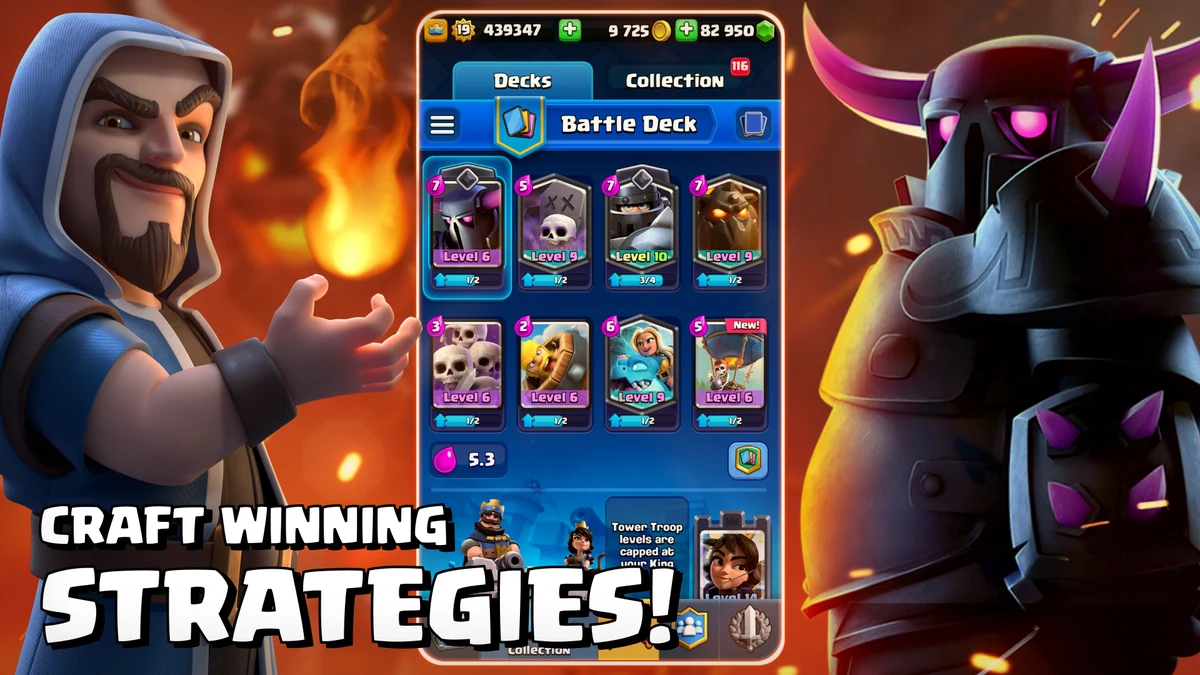
Every new Clash Royale player starts with the same six cards, and the temptation is to throw them onto the battlefield with no real plan. The players who climb fastest in their first few weeks are the ones who understand deck structure before they understand individual card tricks. This guide breaks down the best beginner-friendly decks, why they work, and how to adapt them as new cards unlock on the Trophy Road.
Why Deck Structure Matters More Than Card Rarity
New players often assume that Epic and Legendary cards automatically make a deck stronger. In practice, a well-balanced Common and Rare deck beats a disorganized deck of rare cards almost every time. A good beginner deck needs four things: a win condition that can pressure the tower, cheap cards to answer swarms, at least one building or high-hitpoint troop to stop a big push, and a spell that clears small units. Missing any one of these leaves a hole an opponent will find within the first minute of a match.
The average elixir cost of your deck also matters. Most beginner decks should sit between 3.4 and 4.0 average elixir cost. Anything higher makes you slow to react on defense; anything lower usually means you are relying on a fast cycle strategy that is harder to pilot without experience reading opponent patterns.
The Starter Deck: What You Begin With
Every account opens with Knight, Archers, Giant, Musketeer, Minions, and Mini P.E.K.K.A. This is actually a reasonably solid foundation. The Knight is a cheap mini-tank for three elixir that can hold the front line against small pushes. Archers handle air swarms and can finish off weakened troops. Giant is your win condition, a high-hitpoint tank that will eventually reach the tower if left unanswered. Musketeer provides ranged damage support, Minions punish air-heavy pushes, and Mini P.E.K.K.A. deletes tanky single-target threats. As you climb the early arenas and unlock chests, you will want to add a proper spell like Zap or Arrows and a building such as Cannon or Tesla to round this deck out.
Beginner Deck 1: Giant Beatdown
This is the most forgiving deck archetype for new players because it teaches the fundamentals of building a push behind a tank. A typical version uses Giant as the win condition, supported by Musketeer or Wizard for ranged damage, Mini P.E.K.K.A. or Knight for ground defense, Minions or Minion Horde for air coverage, a cheap swarm answer like Skeletons, a low-cost spell such as Zap, and a splash defense card like Baby Dragon if unlocked. The strategy is simple: let the Giant absorb tower damage while your support troops behind it clear the path. On defense, use your cheaper cards to stall until you have enough elixir to counter-push.
Beginner Deck 2: Hog Rider Cycle
Once Hog Rider unlocks, many players shift toward a faster cycle deck. This style keeps average elixir cost low, often around 3.0 to 3.4, so you can out-cycle your opponent and repeatedly pressure the tower with the Hog Rider while using cheap cards like Ice Spirit, Skeletons, and Cannon to defend efficiently. Cycle decks are less forgiving of mistakes than beatdown decks because every elixir trade matters, but they teach excellent defensive fundamentals and card-counting skills that carry over to every other archetype later in the game.
Beginner Deck 3: Balanced All-Rounder
A hybrid approach works well for players who are still unlocking cards and do not have a full archetype available yet. Combine a mid-cost win condition like Giant or Battle Ram with a mix of defensive troops, one splash unit, one small spell, and one building. The goal at this stage is not to copy a top-ladder deck exactly, since you likely will not have every card unlocked, but to make sure your eight slots cover the four core roles: win condition, swarm defense, tank defense, and spell.
Common Mistakes New Players Make
The biggest mistake is chasing card rarity instead of deck synergy. A Legendary card that does not fit your win condition is often worse than a Common that does. The second mistake is overcommitting elixir on offense and leaving no defense for the counter-push, which is how most beginner matches are actually lost. The third mistake is ignoring the elixir counter entirely. Learning to track your own elixir and estimate your opponent’s is one of the highest-value skills you can build in your first fifty matches. Finally, many new players swap their deck constantly instead of playing the same eight cards for a week or two. Repetition with one deck teaches matchup knowledge that jumping between decks never will.
Adapting Your Deck as You Unlock New Cards
As you progress through the early arenas, new chests will hand you cards you did not choose. Resist the urge to slot in every new card immediately. Instead, ask whether the new card fills a gap your current deck is missing, such as a better spell, a cheaper swarm answer, or a stronger building. If it does, swap it in and play at least ten matches before judging it. For a broader breakdown of arenas, card rarities, and game modes, check out our complete Clash Royale guide, which covers the full progression system from your first match onward.
Practicing Deck Fundamentals in Training Camp and Friendly Battles
Before grinding ranked ladder trophies, spend time in Training Camp or Friendly Battles with clanmates to test a new deck without risking a loss streak. This is especially useful for learning how your win condition performs against common defensive setups and for practicing spell timing, such as when to save Zap for a Skeleton Army versus using it to reset an Inferno Tower. Beginners who spend even thirty minutes in low-stakes practice modes before laddering tend to make far fewer costly misplays once real trophies are on the line.




[…] Royale Card Tier List: Best Cards to Upgrade First (ESRB E10+) Best Clash Royale Decks for Beginners (2026 Guide) (ESRB E10+) Clash Royale Trophy Pushing: Ladder Climbing Tips (ESRB E10+) Clash Royale Clan Wars 2.0 Guide: […]