
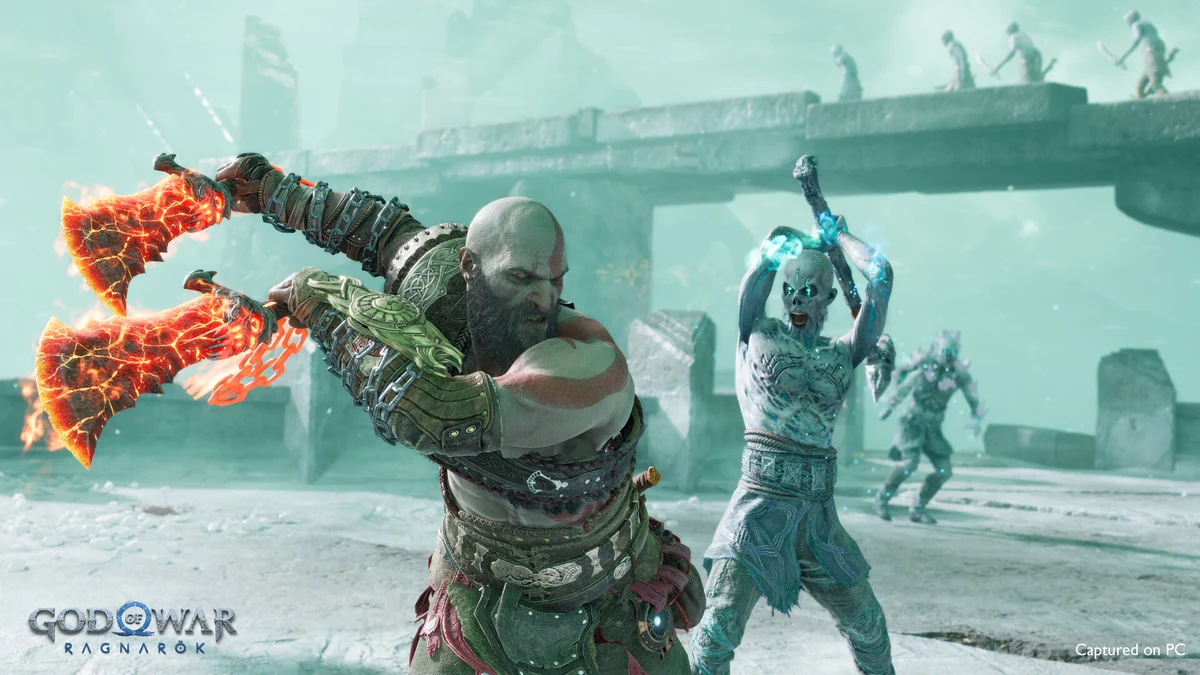
Kratos fights with two very different weapons in God of War Ragnarök, and understanding how they complement each other is the single biggest step toward feeling confident in combat. Where the 2018 God of War eased players into the Leviathan Axe alone, Ragnarök hands you the Blades of Chaos early and expects you to juggle both weapons, a growing skill tree, and a defensive system built around precise timing. This guide breaks down the fundamentals so you can stop button-mashing and start fighting with intention.
Leviathan Axe vs Blades of Chaos: when to use each
The Leviathan Axe is a frost weapon that Kratos throws and recalls, making it excellent for both melee combos and ranged interruptions. Its heavy attacks are slower but hit hard, and its frost damage builds up a status effect that eventually freezes enemies solid, leaving them open to a devastating finisher. The axe is the better choice against single tough enemies, armored foes, and situations where you need to peel an enemy off Atreus or another companion from a distance, since recalling the axe mid-throw can stagger anything in its return path.
The Blades of Chaos, unlocked a short way into the story, are fire-based chain weapons that hit fast and cover a wide arc, making them ideal for crowd control against groups of weaker enemies. They lack the axe’s ranged utility but make up for it with speed, allowing Kratos to chain combos and close distance quickly. Many players find themselves switching mid-fight: axe for the dangerous elite enemy, blades for the mob surrounding it. Learning to swap weapons on the fly with the D-pad, without breaking your combo rhythm, is one of the clearest signs of a player moving from beginner to intermediate.
Later in the story you also gain the Draupnir Spear, a wind-elemental weapon that can be thrown to stick into enemies and detonated for burst damage, but the axe-and-blades combo is the foundation every new player needs to master first.
Understanding runic attacks
Runic attacks are special elemental abilities tied to whichever weapon you have equipped, activated by holding the block button and pressing either the light or heavy attack button. Each weapon has its own pool of runic attacks that you find and unlock as you explore the Nine Realms, and you can equip one light and one heavy runic attack at a time per weapon.
On the Leviathan Axe, attacks like Ivaldi’s Anvil send Kratos leaping into the air before slamming down to create a frost explosion around him, while Breath of Thamur unleashes a wide cyclone that hits everything nearby. These area-of-effect options are invaluable when you’re surrounded, since normal combos can leave you exposed to attacks from outside your immediate target.
The Blades of Chaos favor aggressive, damage-focused runics such as Atlas Eruption, which repeatedly punches the blades into the ground for a string of fiery explosions, or Meteoric Slam, which rains fire down on a target and applies heavy burn damage. Runic attacks consume a resource that regenerates as you fight and land hits, so weaving them into your normal combo strings rather than saving them for emergencies will keep your damage output high across a whole encounter.
Experiment with different combinations early, because the runic attacks you find in the first few hours are rarely the best ones long-term. Chests, Nornir chests, and side content across every realm often hide stronger versions, so it’s worth returning to a weapon’s arsenal later in the game to check what you might have missed.
Parrying, blocking, and reading enemy attacks
Ragnarök uses a color-coded system to tell you how to respond to incoming attacks, and learning to read it on the fly is essential. Attacks with no colored ring at all can be blocked, parried, or dodged, giving you the most freedom. Yellow-ringed attacks cannot be blocked, but they can be parried, and a well-timed parry staggers the enemy and builds their stun meter significantly. Red-ringed attacks cannot be blocked or parried at all and must be dodged. Blue-ringed attacks are a special case: instead of a single parry, you need to double-tap the block button to fully stun the attacker.
Parrying itself is done by pressing the block button just before an attack connects, not the moment you see the warning indicator appear. Pressing too early just results in a normal block, which still reduces damage but doesn’t stagger the enemy or open them up. It takes practice to internalize the timing, and a good way to learn a new enemy type is to deliberately block early during your first few encounters with it, then gradually tighten your timing as you get a feel for its animation. Ranged projectile attacks are usually the easiest parries in the game, since deflecting them back at the source both damages and staggers the attacker.
Dodging and spacing
Dodging is performed by tilting the left stick in a direction and pressing the dodge button, and it’s your only option against red-ringed unblockable attacks. Good spacing matters just as much as reaction time. Many of Ragnarök’s tougher enemies, particularly the game’s optional bosses, chain multiple attacks together with very little warning between them, so dodging out of an enemy’s immediate range after a combo rather than standing your ground to trade hits will keep you alive far longer than trying to out-damage everything.
Shields also play a bigger defensive role in Ragnarök than in the 2018 game. Different shields have different block strength and parry windows, and swapping to one that suits your playstyle, whether that’s a fast-recovery shield for aggressive parrying or a heavier one for raw block strength, is worth doing before you tackle harder optional content.
Building good habits early
New players often lean too hard on one weapon or one input. The fastest way to improve is to treat every fight as practice: try landing a parry instead of a block, try finishing a combo with a runic attack instead of a basic strike, and try switching weapons mid-combo instead of resetting your position first. None of these habits feel necessary on the default difficulty against early enemies, but they become essential once you start chasing the game’s toughest content, including the endgame Valkyrie fights.
If you want a broader walkthrough of the story, realms, and side content alongside these combat fundamentals, check out our complete God of War Ragnarök guide, which ties everything together into a single roadmap for the whole adventure.
Combat tips worth remembering
A few habits consistently separate frustrated players from confident ones. First, use Atreus and your other companions deliberately; commanding them to attack a specific enemy with the companion button can interrupt dangerous attacks you’d otherwise have to dodge yourself. Second, don’t ignore your Spartan Rage meter, which fills as you take and deal damage and can be triggered to heal a portion of your health while dealing bonus damage, making it a useful panic button in a losing fight. Third, invest skill points into stun and finisher-related abilities early, since a stunned enemy that gets finished off outright saves you far more time and health than simply out-damaging it. Combat in Ragnarök rewards patience and observation far more than speed, and once the basics click, even the game’s most punishing fights become readable rather than overwhelming.
[…] Last of Us Survival Tips and Combat Guide (ESRB M) God of War Ragnarök Combat Guide for Beginners (ESRB M) Starfield Ship Building and Combat Guide (ESRB M) War Thunder: The Free-to-Play Vehicle Combat […]