Table of Contents
- What Is Horizon Forbidden West
- The World: A Post-Apocalyptic Earth Ruled by Machines
- Story and Setting: Aloy, GAIA, HADES, and Far Zenith
- Aloy and the Key Characters
- Machine-Hunting Combat and Weapons
- Skills, Skill Trees, and Valor Surges
- Exploration and Traversal: Climbing, Diving, and the Shieldwing
- The Forbidden West Open World
- Burning Shores DLC
- Platforms: PS4, PS5, and the 2024 PC Release
- Critical Reception and Legacy
- Tips for New Players
- Who Is Horizon Forbidden West For
- FAQ
- Conclusion
- External Authority Sources
Six years after Horizon Zero Dawn introduced players to a lush, dangerous Earth reclaimed by mechanical fauna, Guerrilla Games returned with a sequel built to answer the first game’s biggest question: what actually happened to humanity, and can it be saved a second time? Horizon Forbidden West, released on February 18, 2022 for PlayStation 4 and PlayStation 5, picks up Aloy’s journey six months after the events of Zero Dawn and sends her into an unmapped stretch of the American West, from the ruins of Las Vegas to the drowned coastline of Los Angeles. It is a bigger game in almost every sense: a broader map, a deeper combat system, new traversal tools, and a story that finally reveals the identity of the antagonists who doomed the old world. This guide breaks down everything a player needs to know before jumping in, whether you are a returning fan, a newcomer coming from the PC release, or someone deciding if the Burning Shores expansion is worth the price of a PS5. We cover the setting and lore, the machine-hunting combat loop, the skill and weapon systems, exploration mechanics like diving and climbing, the standalone DLC, platform differences, and practical advice for surviving the Forbidden West’s toughest machines.
What Is Horizon Forbidden West
Horizon Forbidden West is an open-world action role-playing game developed by Guerrilla Games and published by Sony Interactive Entertainment. It is the direct sequel to 2017’s Horizon Zero Dawn and the second entry in the Horizon series. Players once again control Aloy, a skilled hunter and outcast of the Nora tribe, as she explores a far-future Earth where civilization has collapsed and been replaced by tribal societies coexisting, often violently, with robotic creatures that resemble animals. The game blends third-person combat against these machines with stealth, RPG-style progression, crafting, and a substantial main story that continues directly from where Zero Dawn left off.
The game launched simultaneously on PlayStation 4 and PlayStation 5, making it one of the last major cross-generation exclusives from Sony before the PS4 was largely phased out of first-party development. A standalone expansion, Burning Shores, arrived in April 2023 as a PS5-exclusive continuation of the story. In March 2024, a Complete Edition bringing the base game and Burning Shores together launched on Windows PC via Steam and the Epic Games Store, opening the series to an entirely new audience.
Guerrilla Games built Forbidden West as a direct response to feedback on Zero Dawn, expanding combat options, adding new traversal abilities, and giving Aloy a wider cast of allies and rivals to interact with across a more varied set of biomes, from desert canyons to underwater ruins to snow-capped mountains.
The World: A Post-Apocalyptic Earth Ruled by Machines
The Horizon series is set roughly a thousand years after a global cataclysm known as the Faro Plague wiped out nearly all human and animal life on Earth. In the backstory established by Horizon Zero Dawn, a company called Faro Automated Solutions built self-replicating robotic machines for military and agricultural use. These machines, designed to consume biomass for fuel, malfunctioned and began devouring the entire biosphere in an event referred to as the Derangement. To prevent total extinction, a scientist named Elisabet Sobeck led Project Zero Dawn, an effort to preserve human DNA and knowledge and eventually reseed the planet with new life, guided by a terraforming super-intelligence called GAIA and its subordinate functions.
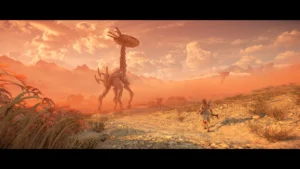
By the time of Horizon Forbidden West, roughly a millennium has passed since that reseeding. Humanity has regrown into disparate tribal societies, each with its own customs, technology level, and relationship to the machines that now roam the land in herds. These machines range from small, skittish Watchers and grazing Grazers to towering combat units like Thunderjaws and Tremortusks. Some serve peaceful ecological functions, harvesting and redistributing resources across the terrain; others were repurposed as weapons during the events of the first game and remain hostile.
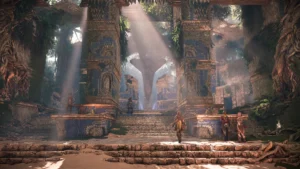
The Forbidden West itself is the western half of what was once the United States, a region so dangerous and unmapped that Aloy’s home tribe, the Nora, considered it off-limits, hence the name. It spans a much wider variety of environments than Zero Dawn’s Rocky Mountain setting, including submerged coastal cities, arid badlands, dense rainforest, and mountain ranges, giving Guerrilla Games room to introduce new machine types, new tribes, and new environmental storytelling opportunities tied to real-world locations like Las Vegas, San Francisco, and the Cascade mountain range.
Story and Setting: Aloy, GAIA, HADES, and Far Zenith
Horizon Forbidden West opens roughly six months after Aloy defeated HADES, the rogue subordinate function that had been trying to trigger a second extinction event at the end of Horizon Zero Dawn. Despite that victory, Aloy discovers a new crisis: a mysterious blight is killing the very organisms GAIA was meant to protect, and the planet’s biosphere is once again collapsing. Complicating matters, GAIA herself is not fully operational. During her final confrontation with HADES, GAIA fragmented into several subordinate functions to keep them out of HADES’s control, and Aloy has spent months searching without success for a way to restore her.
The game’s story follows Aloy as she tracks a signal into the Forbidden West, hoping to find a backup of GAIA and answers about the blight. Along the way she reconnects with GAIA through a recovered subsystem called MINERVA and begins locating the other scattered subfunctions, including AETHER and DEMETER, each guarding a piece of the puzzle needed to fully restore the terraforming system. She also has to contend with HEPHAESTUS, the subfunction responsible for machine manufacturing, which has gone rogue in its own way.
The central mystery deepens when Aloy learns that the extinction-triggering signal which originally corrupted HADES and the other subfunctions did not come from Earth. It originated from the Sirius star system, pointing to an external, human source rather than a purely mechanical failure. This revelation connects to the game’s other major storyline: the Tenakth civil war led by the rebel Regalla, and the arrival of technologically advanced strangers whose existence recontextualizes everything players thought they knew about how the old world ended.
As the story progresses, Aloy uncovers the existence of Far Zenith, a group of extraordinarily wealthy individuals who, before the Faro Plague fully consumed Earth, used advanced technology to leave the planet aboard a colony ship and extend their own lifespans indefinitely. Far Zenith is revealed to be responsible for both the original extinction signal and the renewed threat facing Aloy in the present day, having created a failed artificial intelligence, Nemesis, during an attempted mind-uploading experiment. Nemesis destroyed the Zeniths’ new colony and is now making its way back toward Earth, hunting the surviving Zeniths and threatening the same fate that already befell the old world once. The remaining Zenith members, including a central antagonist named Tilda van der Meer, want to seize GAIA’s rebirth technology for themselves in order to escape Nemesis and start over on another world, regardless of the cost to the people already living on Earth.
This storyline gives Forbidden West a clear escalation from Zero Dawn’s mystery-box structure: the first game was about uncovering what happened to the old world, while the sequel is about confronting the people responsible and stopping history from repeating itself, all while a new, more personal threat closes in on Aloy and her allies.
Aloy and the Key Characters
Aloy remains the protagonist and only playable character. Introduced in Horizon Zero Dawn as an outcast raised outside the Nora tribe’s social structure, she is established as one of the few people alive who understands both the tribal world and the lost technology of the “Old Ones.” By Forbidden West, Aloy is a recognized hero across multiple tribes, but the game leans into her isolation and self-reliance as a character flaw the story actively challenges, pushing her to depend more on allies as the threat grows beyond what she can handle alone.
Several characters return from the first game and take on larger roles in the sequel:
- Varl — A Nora warrior and one of Aloy’s closest friends, who accompanies her into the Forbidden West and takes on more of a leadership role among her traveling companions.
- Erend — An Oseram warrior and former captain of the Sun-King’s Vanguard from Zero Dawn, who rejoins Aloy on her journey west.
- Sylens — A recurring, morally ambiguous figure obsessed with recovering old-world technology, whose motives remain deliberately unclear throughout much of the story.
Forbidden West also introduces a substantial new supporting cast tied to the tribes native to the region:
- Zo — A healer from the Utaru tribe who joins Aloy’s group and develops a relationship with Varl over the course of the story.
- Regalla — The leader of a rebel faction within the Tenakth tribe, whose civil war against the ruling council forms one of the game’s major regional conflicts.
- Kotallo, Alva, and other Tenakth and Utaru allies — Region-specific characters recruited into Aloy’s growing network as she works to unite the West against Far Zenith and the machine threat.
On the antagonist side, Tilda van der Meer stands out as one of the more prominent human villains, a former tech industrialist turned immortal Far Zenith colonist whose manipulation of tribal leaders and personal history with GAIA’s creators ties directly into the story’s core mystery. The shift toward human antagonists, rather than purely rogue AI, is one of the more notable narrative changes from the first game.
Machine-Hunting Combat and Weapons
Combat in Horizon Forbidden West centers on hunting machines, ranging from small scavenger-type units to multi-ton combat behemoths, using a mix of ranged weapons, traps, and environmental tactics. Aloy’s Focus device, a wearable scanning tool, remains central to the loop: it lets players tag enemies to reveal their weak points, armored components, and elemental vulnerabilities before engaging, turning many encounters into a planning exercise as much as a reflex test.
The bow remains Aloy’s signature weapon, but Forbidden West expands the arsenal considerably compared to Zero Dawn. Key weapon types include:
- Hunter Bows — Fast, general-purpose bows for sustained damage against a variety of targets.
- Sharpshot Bows — Long-range precision weapons designed for hitting specific weak points from a distance.
- War Bows — Slower, heavier bows that fire multiple arrows or high-impact rounds for maximum damage.
- Tripcasters — A returning gadget that fires wire traps between two anchor points, creating tripwires that damage or stagger machines that cross them; useful for setting up ambushes.
- Ropecasters — Fire tethers that can be used to bind and immobilize a machine’s limbs, restricting its movement, especially effective against larger targets.
- Boltblasters and Spikethrowers — New additions that offer rapid-fire and ground-based trap options respectively, expanding the tactical toolkit beyond what Zero Dawn offered.
- Shredder Gauntlet — A close-range weapon introduced in Forbidden West that lets Aloy fire discs in melee range, useful when a machine closes the distance.
Elemental damage types, including fire, shock, frost, acid, and plasma, continue to play a major role, since most machines have specific resistances and vulnerabilities that reward players for matching ammunition type to target. Melee combat also received a significant overhaul from the first game, giving Aloy a proper spear-based combo system with light and heavy attacks, dodges, and a resource meter that fuels special techniques, rather than the more limited melee options available in Zero Dawn.
Beyond direct combat, Aloy retains the ability to override certain machines using her Focus, turning them into temporary allies or mounts. Overridden machines can fight on Aloy’s side, and some can be ridden for faster traversal or even used to reach otherwise inaccessible terrain, such as machines capable of swimming or climbing sheer rock faces.
Skills, Skill Trees, and Valor Surges
Aloy’s character progression is organized into six skill trees, each themed around a different playstyle: Hunter, Infiltrator, Machine Master, Survivor, Trapper, and Warrior. As players earn skill points through leveling up and completing quests, they can invest in any of these trees, allowing for a fair amount of build customization even though Aloy remains a single fixed protagonist.
Each tree contains a mix of skill types:
- Active Skills — Abilities that must be manually triggered, such as special attacks or utility moves.
- Passive Boosts — Permanent stat or efficiency improvements that apply automatically.
- Weapon Techniques — Unlockable special moves tied to specific weapon types, such as unique arrow behaviors or melee combos.
- Valor Surges — Powerful, temporary abilities tied to each skill tree that charge up during combat and can be unleashed for a significant tactical advantage.
Valor Surges function as a kind of ultimate ability system layered on top of the regular skill trees. Depending on which tree a player has invested in, Valor Surges can provide effects like a damage-absorbing shield that recharges over time, a burst of healing in the middle of a fight, temporary invisibility for stealth plays, or enhanced melee damage output. Because each tree offers its own distinct Surge, the system encourages players to lean into a preferred tree rather than spreading skill points too thin, while still leaving room for hybrid builds.
The Trapper tree focuses on improving traps, food effectiveness, and gadgets like the Tripcaster and Ropecaster, rewarding players who like to prepare a battlefield before engaging. The Hunter and Warrior trees lean into ranged precision and melee aggression respectively, while Infiltrator rewards stealth takedowns and avoiding detection. Machine Master enhances override capabilities, letting players control tougher machines and use them more effectively in combat, and Survivor improves Aloy’s general resilience, resource management, and healing.
Exploration and Traversal: Climbing, Diving, and the Shieldwing
One of the most significant upgrades over Horizon Zero Dawn is the traversal toolkit, which Guerrilla Games expanded to make the Forbidden West’s varied terrain feel fully explorable rather than gated by invisible walls.
The Pullcaster is a new piece of equipment that stays passively equipped throughout the game rather than occupying a weapon slot. When aimed at specially marked anchor points, it lets Aloy pull down weak walls, drag over ziplines, retrieve items from a distance, or yank apart mechanisms blocking a path, functioning as both a traversal tool and a light puzzle-solving mechanic.
Climbing was also reworked to feel less rigidly scripted than in Zero Dawn. Rather than being limited to predetermined handhold paths, Aloy can identify and scale a wider range of surfaces more fluidly, making vertical exploration feel closer to a natural extension of movement rather than a separate puzzle mode.
The Shieldwing is a glider-style device that Aloy acquires relatively early in the story, allowing her to leap from great heights and glide down safely rather than falling to her death or slowly backtracking down a cliff. It fundamentally changes how players approach elevation in the open world, encouraging exploration of tall structures and mountain peaks that would otherwise be one-way trips.
Underwater exploration is a new pillar of Forbidden West’s traversal systems entirely absent from the first game. Aloy gains a Diving Mask that allows extended underwater breathing, opening up submerged ruins, sunken cities, and coastal machine habitats as explorable spaces. Combined with a redesigned swimming and diving control scheme, this lets Guerrilla Games build entire questlines and points of interest beneath the waterline, including story-critical locations tied to the POSEIDON subfunction.
Together, these tools, the Pullcaster, improved free climbing, the Shieldwing, and diving, make the Forbidden West feel dramatically more vertical and three-dimensional than the original game’s map, rewarding players who explore off the beaten path.
The Forbidden West Open World
The map in Horizon Forbidden West is both larger and more environmentally diverse than Zero Dawn’s setting, stretching across a fictionalized rendition of the real-world American West and Pacific coast. Biomes include coastal wetlands, desert canyons reminiscent of the Southwest, dense redwood-style forests, and snow-covered mountain ranges, each hosting distinct machine types adapted to the local terrain and, in several cases, distinct human tribes with their own culture, architecture, and conflicts.
Notable named regions and locations draw on recognizable real-world geography reimagined a thousand years after collapse, including ruined versions of Las Vegas and the broader Mojave area, as well as coastal zones that hint at the former Bay Area and, later in Burning Shores, Los Angeles. Guerrilla Games used these real-world touchpoints to ground the fiction while still allowing for heavy narrative and environmental reinvention.
The open world is populated with the usual structure of modern open-world design: main story quests, side quests tied to individual characters and settlements, machine sites that reward players for defeating specific enemy configurations, Cauldrons (underground machine-manufacturing facilities that can be infiltrated and overridden), Tallnecks (giant machines that reveal map data when climbed), relic ruins, and collectible data points that flesh out the pre-collapse world through audio logs and documents. Hunting Grounds return as skill-based challenge arenas that test combat proficiency against timed or constrained scenarios, offering some of the best rewards in the game for players willing to master its combat systems.
Guerrilla Games also introduced new tribal factions unique to the Forbidden West, most prominently the Tenakth, a warrior culture divided by the civil war central to the main story, and the Utaru, a more spiritually oriented farming tribe. These factions add regional texture and give side content more narrative weight than simple fetch-quest filler.
Burning Shores DLC
Burning Shores is a story expansion for Horizon Forbidden West released on April 19, 2023, notable for being a PlayStation 5 exclusive; it is not available on PS4, even for players who own the base game on that platform. Players must have completed the main Forbidden West campaign to access it, since the expansion picks up directly after the ending of the base game.
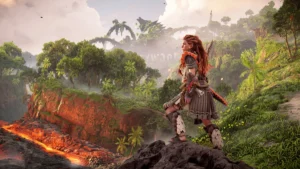
The story follows Aloy as she tracks a lead to the ruins of Los Angeles, hunting down the last known surviving member of Far Zenith in a new, self-contained arc that builds on the base game’s central antagonist storyline. Reviewers generally described Burning Shores as offering roughly eight or more hours of new story and side content, set entirely in a new map area distinct from the main game’s world, featuring new machine types and a volcanic, fire-scarred landscape that gives the expansion its name.
Critically, Burning Shores was praised primarily for its visual presentation. Because it was built exclusively for PS5 hardware rather than as a cross-generation release, Guerrilla Games was able to push graphical fidelity further than the base game allowed, and multiple reviewers singled it out as one of the best-looking games available on the console at the time of release. The expansion does not introduce sweeping new gameplay systems; instead it focuses on delivering more of the combat, exploration, and character-driven storytelling that defined the core game, tightened into a shorter, more focused package.
For PS4 owners who never upgraded to PS5, Burning Shores remains inaccessible, which was a point of frustration among some fans given that the base game supported both platforms at launch. This exclusivity also carried over conceptually to the PC release: while the PC Complete Edition bundles the base game with Burning Shores together, it arrived roughly a year after the PS5 DLC debuted, meaning original console players had a substantial head start on that content.
Platforms: PS4, PS5, and the 2024 PC Release
Horizon Forbidden West originally launched on February 18, 2022, as a cross-generation title for both PlayStation 4 and PlayStation 5. This was a deliberate choice by Sony and Guerrilla Games to ensure the large existing base of PS4 owners, many of whom had played Horizon Zero Dawn, would not be locked out of the sequel. The PS5 version takes advantage of the console’s SSD for faster loading, higher resolution and frame rate options, ray-traced reflections in performance and resolution modes, 3D audio support, and DualSense controller features such as adaptive trigger resistance tied to different bow draw weights and haptic feedback during combat and traversal.
On March 21, 2024, Horizon Forbidden West Complete Edition released on Windows PC via Steam and the Epic Games Store, bringing both the base game and the Burning Shores expansion to PC for the first time in a single package. This followed the same pattern Guerrilla Games and Sony had already established with Horizon Zero Dawn’s earlier PC port, continuing Sony’s broader strategy of bringing former PlayStation exclusives to PC after a period of console exclusivity.
The PC version requires a 64-bit version of Windows 10 or later, and reported minimum specifications call for hardware in the range of an AMD Ryzen 3 1300X or equivalent processor paired with a graphics card around the level of an AMD Radeon RX 5500 XT, along with 16GB of system RAM. The game supports a wide range of graphics presets, from very low to very high, aimed at accommodating everything from modest laptops and handheld PCs to high-end gaming rigs, and features PC-specific enhancements such as ultra-wide monitor support, uncapped frame rates, and DLSS or FSR upscaling options depending on the graphics hardware installed. Storage requirements are substantial, with the full installation reported at around 150GB, reflecting higher-resolution textures and assets bundled for PC hardware compared to the console releases.
For players deciding where to play, the PS5 version remains the most technically polished experience given its native development target and DualSense integration, while the PC Complete Edition offers the most content in a single purchase, bundling Burning Shores in from day one and adding the flexibility of mouse-and-keyboard or controller play, higher frame rate ceilings, and broader display support.
Critical Reception and Legacy
Horizon Forbidden West was well received by critics on release, earning a Metacritic score of 89 based on 92 critic reviews, placing it in the “generally favorable” range and marking it as a clear improvement over Horizon Zero Dawn in the eyes of most reviewers. Critics consistently praised the game’s visual design, the refinement of its combat and traversal systems compared to the first game, and the ambition of its story, particularly the reveal of Far Zenith and the expanded machine roster.
The game was recognized at The Game Awards 2022, winning Best Action Game and receiving nominations across categories including sound design, art direction, and performance, reflecting broad industry recognition beyond just review scores. It also picked up numerous other Game of the Year nominations and wins across outlets throughout 2022 and into 2023.
Not every review was uniformly glowing. A handful of outlets described the game as suffering from a degree of “difficult second album syndrome,” arguing that while individual systems were improved, the overall structure remained close enough to the first game’s formula that it did not feel as fresh as it could have. Some critics also felt the open-world side content, while expanded, occasionally leaned on familiar open-world conventions like collectible hunting and repetitive outpost clearing.
Commercially, the game performed strongly. By the end of its first year on the market, Horizon Forbidden West had sold approximately 8.4 million copies, contributing to a combined franchise total of more than 32.7 million units sold across both Horizon games at that point, according to figures reported by Sony. Its performance helped cement Horizon as one of PlayStation’s flagship first-party franchises alongside series like God of War and The Last of Us, and its eventual arrival on PC in 2024 extended that commercial reach to an entirely new audience of players who had never owned a PlayStation console.
Tips for New Players
Players jumping into Horizon Forbidden West for the first time, whether on console or the newer PC release, can benefit from a few practical strategies:
- Use the Focus constantly. Scanning machines before engaging reveals weak points, detachable components, and elemental weaknesses. Skipping this step turns fights into guesswork and wastes ammunition.
- Match elemental damage to machine type. Fire is generally effective against frost-based or organic-adjacent machines, while shock is excellent for disabling heavily armored or mechanical units temporarily. Check a machine’s resistances in the Focus scan before committing to a loadout.
- Invest in the Trapper tree early. Tripcasters and traps can neutralize dangerous machines before a direct fight even begins, which is especially valuable against larger enemies that can quickly overwhelm an underleveled Aloy.
- Don’t ignore side quests and errands. Many of Forbidden West’s best weapons, outfits, and skill-point-granting activities are tied to side content and Hunting Grounds challenges rather than the main story path.
- Use the Pullcaster and Shieldwing to explore vertically. Some of the most valuable loot and lore collectibles are located on cliffsides, towers, and rooftops that are easy to miss if a player sticks strictly to ground-level paths.
- Override machines for mounts, not just allies. Certain overridden machines dramatically speed up traversal across specific terrain types, including water and steep inclines, and are worth prioritizing even for players who don’t plan to keep them as combat allies.
- On PC, adjust graphics presets to your hardware rather than defaulting to Very High. Given the game’s substantial hardware range of supported presets, players on mid-range systems should test a few settings tiers to find a stable frame rate before committing to a full playthrough.
- Complete the base game and its post-game content before starting Burning Shores. The DLC assumes players have finished Forbidden West’s main story and is balanced around a higher-level Aloy.
Who Is Horizon Forbidden West For
Horizon Forbidden West is best suited to players who enjoy open-world action RPGs with a strong emphasis on tactical, preparation-driven combat rather than pure reflex-based action. Fans of the “hunt and dismantle a giant robotic beast” gameplay loop popularized by games like Monster Hunter will find a lot to like in how Forbidden West structures its larger machine encounters, even though the underlying combat mechanics differ significantly.
It is also a strong fit for players who value narrative-driven open worlds with substantial lore, given the density of audio logs, environmental storytelling, and character-driven side quests layered across the map. Newcomers to the series can technically start with Forbidden West, since the game recaps key Zero Dawn plot points, but players who want the full emotional and narrative payoff, particularly around Aloy’s origins and her relationship with Elisabet Sobeck’s legacy, will get more out of the story having played Horizon Zero Dawn first.
Players primarily interested in fast, twitch-based combat or PvP-style multiplayer should look elsewhere, since Forbidden West is a single-player, story-focused experience with no competitive multiplayer component. Similarly, players who dislike large, activity-dense open-world maps with significant amounts of side content may find some of Forbidden West’s map density closer to a chore than a feature, a criticism echoed by some of the more mixed reviews at launch.
FAQ
Do I need to play Horizon Zero Dawn before Horizon Forbidden West? It is not strictly required, since Forbidden West includes recap material covering the essential plot points from the first game. However, players who have completed Zero Dawn will have a much deeper understanding of Aloy’s backstory, GAIA’s origins, and the significance of characters like Sylens, which enhances the emotional impact of Forbidden West’s story.
Is Burning Shores included with the base game? On PS4 and PS5, Burning Shores is a separate paid expansion that must be purchased individually and is only playable on PS5. On PC, the Complete Edition released in March 2024 bundles both the base game and Burning Shores together in a single purchase.
Can I play Horizon Forbidden West on PS4? Yes, the base game launched simultaneously on PS4 and PS5 in February 2022 and supports cross-generation play, though the Burning Shores DLC is exclusive to PS5 and cannot be played on PS4 even with a valid base game license.
When did Horizon Forbidden West come out on PC? The Complete Edition, including Burning Shores, launched on PC via Steam and the Epic Games Store on March 21, 2024, more than two years after the original PlayStation release.
What is the Forbidden West in the story? The Forbidden West refers to the western regions of a post-apocalyptic North America that Aloy’s home tribe, the Nora, historically considered too dangerous to enter. It becomes the central setting of the game as Aloy travels there to investigate a mysterious blight and restore GAIA’s function.
How long is Horizon Forbidden West? Completing the main story generally takes in the range of 25 to 30 hours, while a full playthrough including major side quests, Hunting Grounds, and exploration content typically extends well beyond 50 hours, before factoring in the additional roughly 8-plus hours offered by the Burning Shores expansion.
Conclusion
Horizon Forbidden West succeeds as a sequel by doing exactly what strong follow-ups should: it keeps everything that worked about Horizon Zero Dawn’s machine-hunting core while meaningfully expanding the traversal, combat, and narrative systems built around it. The addition of diving, climbing, and gliding turns the Forbidden West into one of the more vertically ambitious open worlds on PlayStation hardware, while the deepened weapon roster, six-branch skill tree structure, and Valor Surge system give players more room to build a hunting style that fits their preferences. The story’s pivot toward Far Zenith gives the series a clearer, more human antagonist to build future entries around, setting up the world established across Zero Dawn and Forbidden West for further expansion. With the Burning Shores DLC extending the PS5 experience and the 2024 Complete Edition finally bringing the full package to PC, Horizon Forbidden West is more accessible now than at any point since its original 2022 launch, making this a good time for new players to step into Aloy’s boots and see what happened to the old world.
External Authority Sources
- Horizon Forbidden West – Official PlayStation Page
- Horizon Forbidden West Critic Reviews – Metacritic
- Horizon Forbidden West Complete Edition PC Specifications – PlayStation.Blog
- Sony: Horizon Forbidden West Has Sold 8.4 Million Copies – Video Games Chronicle