
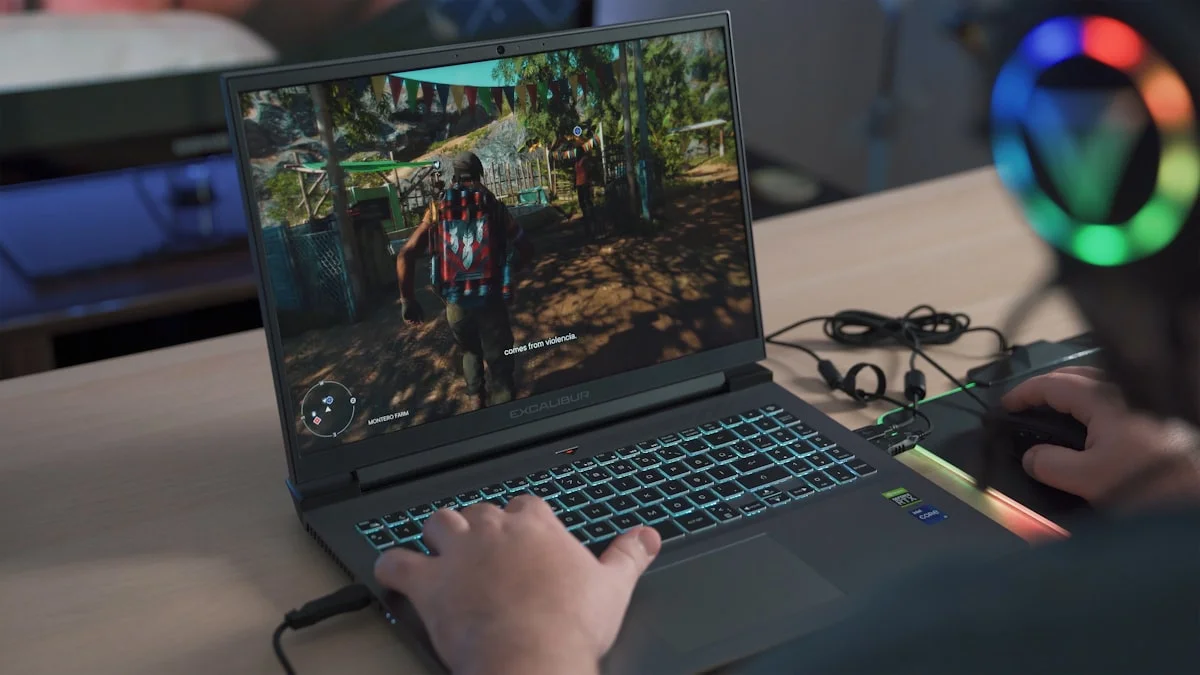
The gaming laptop versus desktop debate never really gets resolved, because it isn’t actually one question — it’s several different questions bundled together, and different gamers weight them completely differently. Performance, price, portability, upgradability, and thermals all pull in different directions depending on what you value, and the right answer genuinely depends on your living situation and how you play far more than it depends on which option is objectively “better.” Here’s how the tradeoffs actually shake out in 2026.
Performance Per Dollar
Desktops have always offered better raw performance per dollar than laptops, and that gap remains substantial in 2026. A big part of this comes down to how mobile graphics chips are engineered: laptop GPUs share naming with their desktop counterparts but run at significantly lower power limits to manage heat and battery life in a thin chassis, which means a mobile GPU often performs closer to a lower desktop tier than its name suggests. A desktop graphics card running at full power, in a case built for airflow, will consistently outperform the laptop version of that same chip family by a wide margin, and that difference compounds at higher resolutions and settings where sustained power delivery matters most.
The price side compounds this further. Comparable performance in a laptop typically carries a real premium over a desktop, because you’re paying for the engineering required to fit that performance into a compact, battery-powered, thermally constrained package. If pure frames-per-dollar is your priority and portability isn’t a factor for you, a desktop is very hard to beat. That said, the gap narrows somewhat at the entry level, where budget desktops and budget gaming laptops both make real compromises, and it’s worth comparing specific current listings rather than assuming the gap is always identical across every price tier.
Upgradability
This is the area where desktops have an almost categorical advantage. A desktop PC is built around standardized, swappable components — you can upgrade the graphics card, add memory, swap the storage drive, or even replace the entire motherboard and processor, all while keeping your case, power supply, and peripherals. This means a desktop’s usable lifespan can be extended significantly over the years by targeted upgrades rather than a full replacement, and it also means repairs are typically cheaper and easier, since a failed individual component can usually be swapped without touching the rest of the system.
Laptops, by contrast, are largely fixed once purchased. Storage and memory are upgradable on many models, but the graphics processor and CPU are soldered to the motherboard and essentially permanent for the life of the machine. This isn’t a flaw so much as a necessary tradeoff for achieving a thin, portable, battery-efficient design, but it does mean that when you buy a gaming laptop, you’re committing to its performance ceiling for its entire useful life in a way you simply aren’t with a desktop.
Portability and Where You Actually Game
Portability is the single clearest reason to choose a laptop, and for a meaningful number of gamers it’s decisive on its own. If you move between locations regularly — a dorm room and home, different apartments, travel for work, or simply wanting to game in different rooms of your own house without building a second setup — a laptop lets you bring your entire gaming library and settings with you in a way a desktop never can. It also solves the simple space problem for anyone living somewhere that doesn’t have room for a dedicated desktop tower, monitor, and peripheral setup. If none of that applies to you and your gaming happens in one fixed spot, portability isn’t earning you anything, and you’re paying the laptop premium for a feature you won’t use.
Thermals and Sustained Performance
Thermals are where the practical, day-to-day experience of laptop gaming diverges most from desktop gaming, even when the on-paper specs look comparable. A desktop tower has room for large heatsinks, multiple fans, and unrestricted airflow, letting components run at their full rated power continuously without throttling, even during long, demanding sessions. A gaming laptop is fighting a much harder battle: the same or similar chips need to be cooled in a fraction of the space, which means laptop manufacturers tune components to run at reduced power targets specifically to keep temperatures and fan noise manageable. In practice, this shows up as laptops sometimes running hot and loud under sustained load, and in some cases gradually reducing clock speeds during extended gaming sessions to stay within safe temperature limits, a behavior that’s far less common on a well-cooled desktop. If you play in long, intense sessions where sustained peak performance really matters, this is a real consideration, not just a spec-sheet abstraction.
Which Gamer Each Option Actually Suits
A desktop makes the most sense if you have a dedicated space to keep it, you want the best possible performance for your budget, you value being able to upgrade individual components over the years rather than replacing the whole system, and portability isn’t a real factor in how you live or play. This describes a large share of serious PC gamers, particularly anyone planning to keep their system for several years and upgrade it incrementally.
A laptop makes the most sense if you genuinely need to move your gaming setup between locations, you have limited space for a permanent desktop setup, you want a single machine that handles both gaming and everyday computing or work tasks, or you simply prioritize the convenience of one self-contained device over squeezing out the maximum performance per dollar. It’s also worth being honest with yourself about a middle path: some gamers buy a modest laptop for portability and everyday use while accepting they’ll play their most demanding games at somewhat lower settings, rather than trying to get desktop-tier performance out of a portable machine. There’s no universally correct answer here — only the one that matches how you actually live and play, and the most common regret on either side of this decision comes from buying based on aspiration rather than genuinely honest self-assessment of your setup, space, and habits.