Table of Contents
- What Is Mario Kart? A Franchise Overview
- Mario Kart World: The Switch 2 Launch Title
- Knockout Tour and Free Roam Explained
- Mario Kart 8 Deluxe: The Best-Selling Kart Racer Ever
- The Booster Course Pass DLC
- Characters, Karts, and Customization
- Items and Core Gameplay Mechanics
- Battle Mode
- Online Multiplayer
- Platforms and How to Play
- Tips for New Players
- Mario Kart World vs. Mario Kart 8 Deluxe: Quick Comparison
- Who Mario Kart Is For
- FAQ
- Conclusion
- External Authority Sources
Few video game franchises have earned the kind of cross-generational trust that Mario Kart commands. It has been the reason families buy a Nintendo console, the go-to party game at every birthday since the 1990s, and, as of 2025, the flagship experience selling a brand-new $449.99 piece of hardware. Two entries define the series right now: Mario Kart World, the open-world reinvention that launched alongside the Nintendo Switch 2 on June 5, 2025, and Mario Kart 8 Deluxe, the 2017 Switch classic that has become the best-selling Mario Kart game of all time and one of the best-selling video games in history. This guide walks through both titles in detail — how they play, what separates them, what critics and sales figures say about them, and what a new or returning player actually needs to know before picking up a controller. Whether you already own a Switch 2 and are deciding whether Mario Kart World justifies its $79.99 price tag, or you are still weighing whether the eight-year-old Mario Kart 8 Deluxe is worth adding to your library, the sections below cover gameplay, items, characters, vehicles, battle mode, online play, and practical buying advice, all grounded in verified facts about each release.
What Is Mario Kart? A Franchise Overview
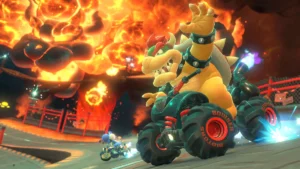
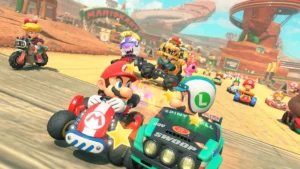
Mario Kart is Nintendo’s kart-racing series starring Mario, Luigi, Peach, Bowser, and dozens of other characters from the Mushroom Kingdom, racing go-karts, motorcycles, and other vehicles across themed circuits while collecting power-up items that can help their own run or sabotage rivals. The series began on the Super Nintendo in 1992 and has released a new mainline entry on nearly every Nintendo home console and handheld since, including the Nintendo 64, GameCube, Wii, Wii U, Nintendo 3DS, and Switch. The formula has stayed remarkably consistent for more than three decades: pick a character, pick a vehicle, race a course while grabbing item boxes, and use bananas, shells, and stars to gain an edge. What has changed dramatically over time is scale, visual fidelity, and how much the series leans into chaos as an equalizer — items are famously designed so a last-place racer has a real chance of catching the leader, which is a big part of why Mario Kart works so well as a party game for players of mixed skill levels. The two entries covered in depth here, Mario Kart World and Mario Kart 8 Deluxe, represent the current and immediately preceding generation of the series, and together they cover the vast majority of what a modern Nintendo player will actually experience.
Across its history, Mario Kart has followed a familiar structural rhythm even as the technology behind it changed. Races are traditionally organized into Grand Prix cups, groups of four courses raced back-to-back with points awarded for finishing position, and a final overall ranking determined once all four races conclude. Cups are themed and named after recurring series icons — Mushroom Cup, Flower Cup, Star Cup, Special Cup, and so on — and unlocking higher-tier cups by placing well in earlier ones has been a series staple since the very first game. Engine classes (measured in cc, standing for cubic centimeters, a nod to real-world go-kart racing) control the speed and difficulty of a given Grand Prix run, with higher classes demanding sharper reflexes and better item timing. Both Mario Kart World and Mario Kart 8 Deluxe preserve this Grand Prix backbone even as they diverge sharply in how the actual courses are presented and connected to one another, which is the central design difference explored throughout this guide.
The series has also long been a technical showcase for whatever Nintendo hardware it launches on. Mario Kart 64 introduced true 3D courses and four-player split-screen; Mario Kart: Double Dash!! let two characters share a single kart; Mario Kart DS added online play for the first time; Mario Kart Wii introduced motorbikes and motion-controlled steering; and Mario Kart 8 introduced anti-gravity racing on Wii U. Mario Kart World continues that tradition by being built specifically to demonstrate what Nintendo Switch 2 hardware can do, using the console’s added processing power to render a persistent, seamless open world with two dozen racers on screen at once — a scale that would not have been feasible on the original Switch.
Mario Kart World: The Switch 2 Launch Title
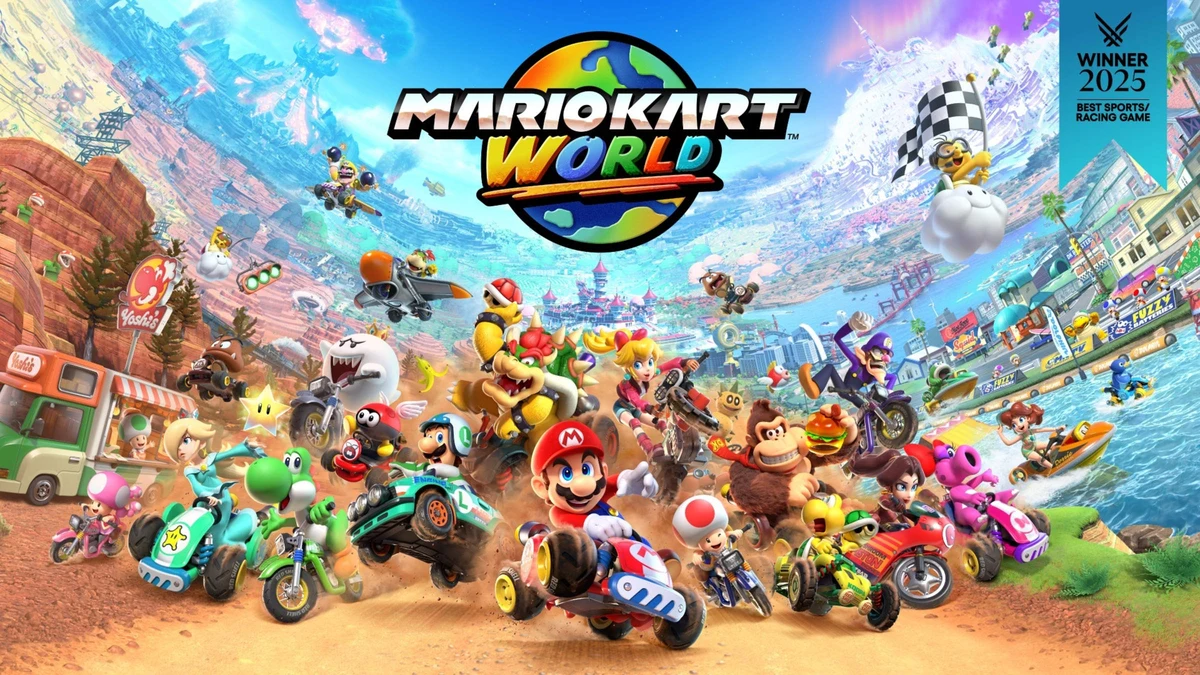
Mario Kart World was released on June 5, 2025, as a launch title for the Nintendo Switch 2, arriving the same day as the console itself. It carries a standalone price of $79.99 and is also sold bundled with the Switch 2 hardware for $499.99. This is the first mainline Mario Kart to break away from the series’ traditional structure of selecting individual, self-contained courses from a menu. Instead, Mario Kart World connects every track into a single, continuous open world that players can drive across freely, with 24 racers competing in each event — the largest field the series has ever supported, up from 12 in earlier games and the increased-but-still-smaller counts of recent entries.
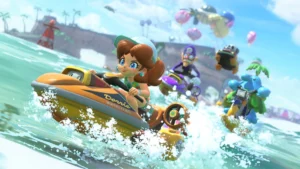
Vehicles in Mario Kart World are not limited to traditional karts. Players can pilot karts, motorcycles, boats, trucks, snowmobiles, and even planes, depending on the terrain a course demands, and the open-world design means a single race can transition through several of these vehicle types as the road turns to water, snow, or open sky. Courses are stitched together geographically rather than existing as isolated levels, so the drive between tracks is itself part of the game, filled with detours, wildlife, hidden paths, and small environmental secrets. This is the most significant structural change to a mainline Mario Kart since the introduction of anti-gravity driving in Mario Kart 8, and it fundamentally changes how a “track” is defined in the series.
Knockout Tour and Free Roam Explained
Mario Kart World introduces two headline modes built specifically around its open-world structure. The Knockout Tour is an elimination-style endurance mode in which racers tackle a long sequence of connected courses back-to-back across the game world, with the lowest-placed drivers getting knocked out at intervals as the tour progresses. It rewards sustained consistency rather than a single strong lap, and it is the mode most directly enabled by the game’s interconnected map, since the “tour” genuinely travels across the open world instead of loading discrete, unrelated tracks.
The second headline feature is Free Roam, a sandbox mode that lets players explore the entire game world at their own pace, outside of any race or time pressure. In Free Roam, players can drive across every region of the map, search for collectibles and oddities, discover secrets tucked away off the beaten path, and simply get a feel for the world’s geography before or between races. Free Roam can be played solo or, thanks to the game’s 24-player online capacity, alongside other racers exploring the same space, turning it into a genuinely social, low-stakes hangout mode rather than just a practice tool. Together, Knockout Tour and Free Roam are the two clearest examples of how Mario Kart World uses its open-world redesign to create experiences that were structurally impossible in earlier, course-select-based entries.
Mario Kart 8 Deluxe: The Best-Selling Kart Racer Ever
Mario Kart 8 Deluxe launched on Nintendo Switch in 2017 as an enhanced port of the Wii U’s Mario Kart 8, folding in all of that game’s DLC, adding new characters, and introducing a proper Battle Mode with dedicated arenas. What has happened to the game commercially since then is extraordinary. As of Nintendo’s fiscal year data, Mario Kart 8 Deluxe has sold roughly 68.2 million units lifetime, including 6.23 million copies in the fiscal year ending March 31, 2025, and a further 2.39 million copies between April and December 2025 alone — remarkable for a game approaching its ninth year on the market. That places Mario Kart 8 Deluxe as Nintendo’s best-selling game of all time when Wii Sports (originally a pack-in title) isn’t counted as a standalone release, ahead of Animal Crossing: New Horizons (47.82 million) and Super Smash Bros. Ultimate (36.24 million). Combined with the original Wii U version’s sales, the Mario Kart 8 install base ranks among the five best-selling video games ever made, trailing only Tetris, Minecraft, Grand Theft Auto V, and Wii Sports.
Mechanically, Mario Kart 8 Deluxe is built around anti-gravity driving, a feature introduced in the original Mario Kart 8 that lets karts hover, drive up walls, and race upside-down on specially designed sections of track, with tires turning sideways and glowing blue while active. Drivers in anti-gravity mode can pick up Spin Boosts by bumping into rival racers or driving through Spin Boost Pillars, adding a layer of aggressive positioning that didn’t exist in earlier games. The game also introduced a 200cc engine class on top of the traditional 50cc, 100cc, and 150cc speeds, offering a genuinely difficult, high-speed mode for experienced players, alongside accessibility options like Smart Steering, which automatically keeps a vehicle on the track and off walls (at the cost of skipping shortcuts), and Auto-Accelerate, which removes the need to hold the acceleration button — both aimed at making the game approachable for younger or less experienced racers without changing the core experience for everyone else.
The Booster Course Pass DLC
The single biggest addition to Mario Kart 8 Deluxe’s lifespan was the Booster Course Pass, a paid DLC pack priced at $25 that ultimately added 48 new tracks to the game, delivered in six waves between 2022 and 2023, with the final wave releasing on November 9, 2023. Combined with the base game’s 48 courses, the Booster Course Pass brought Mario Kart 8 Deluxe’s total course count to 96 tracks — nearly double what any previous Mario Kart game had offered and, at the time, the largest course roster in franchise history.
Most Booster Course Pass tracks are remastered courses pulled from earlier entries in the series’ history, spanning the Super Nintendo, Nintendo 64, GameCube, DS, Wii, 3DS, and Wii U eras, rebuilt with Mario Kart 8’s visual fidelity and anti-gravity sections layered in where it made sense. A significant portion of the pack also brought over tracks originally built for the mobile spin-off Mario Kart Tour, marking those courses’ console debut. Notable additions across the six waves include Tour Paris Promenade, 3DS Toad Circuit, N64 Choco Mountain, Wii Coconut Mall, Tour Tokyo Blur, DS Shroom Ridge, GBA Sky Garden, and Ninja Hideaway. The Booster Course Pass is also included at no extra cost for anyone subscribed to Nintendo Switch Online’s Expansion Pack tier, and it was later made available as a standalone retail release. For anyone who already owns Mario Kart 8 Deluxe, the Booster Course Pass is the single most impactful purchase available to extend the game, effectively doubling its content years after the original launch.
Characters, Karts, and Customization
Character rosters have grown steadily across recent Mario Kart entries, and Mario Kart World currently holds the record with 50 playable characters, edging past Mario Kart 8 Deluxe’s previous high of 48. Both games draw from the same well of Mushroom Kingdom regulars — Mario, Luigi, Peach, Daisy, Yoshi, Toad, Bowser, and dozens of others, including baby versions, Koopalings, and more unusual picks that have become series traditions.
Vehicle customization works differently between the two games, and it’s one of the more debated changes in Mario Kart World. Mario Kart 8 Deluxe uses the modular kart-building system the series adopted starting with Mario Kart 7: players mix and match a chassis, tires, and glider independently, with each part affecting stats like speed, acceleration, weight, handling, and traction, allowing for a huge number of statistically distinct builds. Mario Kart World moves away from fully modular parts customization in favor of a large selection of premade vehicle builds for players to choose from directly — with 40 total vehicles (21 karts, 11 bikes, six trikes, and two “mobiles”) that combine with the 50-character roster for 6,120 possible character-vehicle combinations. Vehicles are unlocked by collecting coins during play rather than by completing Grand Prix cups.
What Mario Kart World adds instead of parts customization is character outfits, a system carried over and expanded from Mario Kart Tour. Every character has at least two alternate appearances, and outfits are unlocked by eating specific “Dash Food” items — golden food bags found at Yoshi-run drive-thru stands scattered around the open world, many of which are specific to a particular course or region — while playing as that character. Players can also apply stickers and decals to their vehicles, earned by completing in-game objectives, giving a lighter, more cosmetic form of customization than the stat-based system in Mario Kart 8 Deluxe.
Items and Core Gameplay Mechanics
Items remain the heart of Mario Kart’s competitive balance in both games, and the classics are all present: Green Shells, Red Shells, Bananas, Mushrooms, the Star, and the dreaded Spiny (Blue) Shell that targets whoever is in first place. Mario Kart 8 Deluxe’s item pool reflects its Wii U origins with a relatively stable, well-worn set that longtime fans know well, refined through years of balance tweaks across its DLC waves.
Mario Kart World expands the item roster to a total of 28 items, including six brand-new additions built around its open-world design: the Coin Shell, which releases a trail of coins as it travels, letting nearby racers scoop them up to boost their maximum speed; the Ice Flower, which leaves rivals in a frosty spin-out when hit; the Hammer, which can be thrown to block a rival’s drift path and stun them; the Feather, a returning classic (originally from the very first Super Mario Kart) reworked to let racers jump onto grind rails or leap over obstacles and incoming shells; the Mega Mushroom, which returns from Mario Kart Wii and temporarily grows the player and their vehicle so they can flatten smaller racers; and Kamek, a chaotic new item that transforms racers in unpredictable ways when triggered. Because Mario Kart World’s courses connect into a continuous, varied world with rails, water, and off-road sections built directly into normal routes, several of these items — particularly the Feather’s grind-rail utility — are tied closely to techniques that simply didn’t exist as core mechanics in prior games.
Battle Mode
Battle Mode has had an uneven history in the series, and Mario Kart 8 Deluxe was widely seen as a course correction. The original Wii U version of Mario Kart 8 was criticized for repurposing regular race tracks as battle arenas, which didn’t suit the mode well. Mario Kart 8 Deluxe fixed this by building dedicated battle courses in the style of the arenas from the series’ first seven games, including maps like Battle Stadium and Lunar Colony, both of which incorporate anti-gravity sections. The Deluxe version also restored classic modes including Balloon Battle, Bob-omb Blast, Coin Runners, Renegade Roundup, and Shine Thief, giving the mode real variety again after years of a stripped-down Wii U implementation.
Mario Kart World carries Battle Mode forward with Balloon Battle and Coin Runners confirmed as available modes, playable both locally and online with up to 24 players contesting a match — again, the largest player count the series has offered for battle play. Given the open-world redesign of the racing modes, Battle Mode in Mario Kart World continues to use dedicated, self-contained arenas rather than the free-roaming map, keeping the mode’s tighter, more chaotic pace intact.
Online Multiplayer
Online play is central to both games. Mario Kart 8 Deluxe supports online races and battles for up to 12 players through Nintendo Switch Online, along with tournaments, regional and worldwide rankings, and the ability to create custom online rooms with friends using specific rule sets. It remains one of the most consistently populated online games on Switch nearly nine years after launch, a testament to its sales longevity.
Mario Kart World raises the online player count dramatically, supporting races and battles with up to 24 players total (yourself plus 23 others) across both modes. It also takes advantage of Switch 2 platform features unavailable on the original console: GameChat lets players talk to friends by voice while racing or roaming the open world together, and CameraPlay lets players see friends’ faces displayed next to their vehicles in real time during a race, whether playing online or on the same couch. These features tie directly into the Switch 2’s built-in camera and chat functionality and represent a genuine step up in how social the online experience feels compared to Mario Kart 8 Deluxe’s more conventional online lobby structure.
Platforms and How to Play
Mario Kart 8 Deluxe is exclusive to the original Nintendo Switch family, including the Switch, Switch Lite, and Switch OLED Model, and it is also playable on Nintendo Switch 2 through backward compatibility. It can be purchased as a physical cartridge or as a digital download, and the Booster Course Pass DLC is included free for Nintendo Switch Online Expansion Pack subscribers or purchasable separately.
Mario Kart World is exclusive to the Nintendo Switch 2 and does not run on the original Switch hardware, since it relies on the more powerful console for its open-world design and larger player counts. It’s available physically and digitally for $79.99, or as part of a $499.99 bundle with the Switch 2 console itself, which was one of the two configurations Nintendo offered at the console’s June 2025 launch. Anyone deciding between the two games first needs to check which console they own: Switch owners without a Switch 2 can only play Mario Kart 8 Deluxe, while Switch 2 owners can play both, since Mario Kart 8 Deluxe runs on the newer hardware as well.
Tips for New Players
New racers benefit most from learning a handful of fundamentals rather than memorizing every track. Drifting is the single most important skill in the series: holding the drift button and steering into a turn builds up a Mini-Turbo boost, shown as a colored spark under the kart, and releasing the drift at the right moment fires off a speed boost — orange sparks give a small boost, and holding longer for blue and eventually purple/rainbow sparks (in Mario Kart 8 Deluxe and Mario Kart World respectively) gives progressively stronger ones. Learning to drift consistently through corners, rather than braking, is the biggest single jump in skill for a beginner.
Item management matters as much as driving skill. Holding onto a shell to use as a defensive shield, saving a Mushroom for a shortcut instead of a straightaway, and knowing when to use a Banana defensively behind the kart versus offensively ahead of a rival all separate stronger players from weaker ones. Beginners playing Mario Kart 8 Deluxe should turn on Smart Steering and Auto-Accelerate if racing feels overwhelming, since both can be toggled per-player in the same race without affecting more experienced racers in the same match. In Mario Kart World, new players should spend time in Free Roam before jumping into ranked-style online races, since the open world rewards familiarity with its geography, shortcuts, and Dash Food locations in a way that traditional track-select Mario Kart games never required. Finally, in both games, racing in lower engine classes (50cc or 100cc) is the right way to learn a track before attempting 150cc or the more demanding 200cc class.
Weight class also matters more than most beginners realize. Every character and vehicle combination falls somewhere on a spectrum from lightweight to heavyweight, and that placement affects top speed, acceleration, and how much a racer gets knocked around when bumped by rivals. Lightweight combinations (characters like Toad or Koopa Troopa paired with nimble karts) accelerate quickly and turn tightly, making them forgiving for beginners still learning a track’s layout, but they get shoved around easily in item-heavy traffic. Heavyweight combinations (Bowser, Donkey Kong, Wario) hit a higher top speed and can barge through smaller racers, but they’re slower off the line and less forgiving of drifting mistakes. Medium-weight characters like Mario and Luigi offer the most balanced starting point for players still figuring out which playstyle suits them.
Course knowledge compounds over time, so it’s worth treating every new track — or, in Mario Kart World’s case, every new region of the map — as something to actively study rather than passively drive through. Watching for item box clusters, learning where off-road shortcuts exist, and noting which corners reward a long drift versus a series of short taps all pay off far more than raw reflexes in the long run. In Mario Kart 8 Deluxe specifically, Time Trial mode (with its ghost data feature) is an underused tool for exactly this kind of practice, since it strips away items and opponents entirely and lets a player run a course on repeat until the racing line becomes second nature.
Mario Kart World vs. Mario Kart 8 Deluxe: Quick Comparison
For readers who want the differences at a glance before deciding which game — or whether both — belongs in their library, here is how the two titles stack up across the categories covered in this guide:
- Release date: Mario Kart 8 Deluxe launched April 28, 2017, on Nintendo Switch; Mario Kart World launched June 5, 2025, on Nintendo Switch 2.
- Platform: Mario Kart 8 Deluxe runs on Switch, Switch Lite, Switch OLED Model, and Switch 2 (backward compatible); Mario Kart World is Switch 2 exclusive.
- Price: Mario Kart 8 Deluxe typically retails around $59.99 standalone; Mario Kart World is $79.99, or bundled with a Switch 2 console for $499.99.
- Course structure: Mario Kart 8 Deluxe uses traditional, individually selected courses; Mario Kart World uses a connected, explorable open world.
- Total courses: Mario Kart 8 Deluxe has 96 courses with the Booster Course Pass installed; Mario Kart World’s tracks are woven into its open world rather than counted as a traditional separate roster.
- Characters: 48 in Mario Kart 8 Deluxe versus 50 in Mario Kart World.
- Vehicles: Mario Kart 8 Deluxe uses modular chassis/tire/glider parts; Mario Kart World offers 40 premade vehicles across karts, bikes, trikes, and mobiles.
- Max online players: 12 in Mario Kart 8 Deluxe; 24 in Mario Kart World.
- Signature modes: Mario Kart 8 Deluxe is defined by its Grand Prix cups, 200cc class, and rebuilt Battle Mode arenas; Mario Kart World is defined by Knockout Tour and Free Roam.
- Metacritic score: 92 for Mario Kart 8 Deluxe versus 86 for Mario Kart World.
- Lifetime sales: Roughly 68.2 million units for Mario Kart 8 Deluxe as of late 2025; Mario Kart World’s sales are still climbing as a 2025 release tied to Switch 2 adoption.
Who It’s For
Mario Kart’s enduring appeal comes from how well it scales across skill levels and group sizes. As a couch multiplayer game, both Mario Kart 8 Deluxe and Mario Kart World support local split-screen play for family game nights or parties, and the item-based rubber-banding system genuinely gives less experienced players a chance to win, which keeps mixed-skill groups engaged in a way that most competitive racing games can’t. Mario Kart 8 Deluxe is the better entry point for anyone who owns an original Switch, for budget-conscious buyers, or for players who specifically want the deep, stat-based kart customization and a battle-tested online community with nearly nine years of support. Mario Kart World is the clear pick for anyone who has or is planning to buy a Switch 2, for players drawn to open-world exploration on top of traditional racing, and for groups who want the largest possible player counts in both racing and battle modes. Competitive and time-trial-focused players will find deeper community infrastructure and more established meta knowledge around Mario Kart 8 Deluxe simply because it has existed far longer, while players looking for the newest, most technically ambitious version of the series should prioritize Mario Kart World.
FAQ
Is Mario Kart World a sequel to Mario Kart 8 Deluxe? Mario Kart World is a new, standalone mainline entry rather than a direct sequel or remaster. It shares series fundamentals like drifting, items, and character-based racing with Mario Kart 8 Deluxe but introduces a new open-world structure, a larger 24-player format, and modes like Knockout Tour and Free Roam that didn’t exist in the earlier game.
Can I play Mario Kart 8 Deluxe on the Nintendo Switch 2? Yes. Mario Kart 8 Deluxe is backward compatible and runs on Switch 2 hardware, while Mario Kart World is exclusive to Switch 2 and does not run on the original Nintendo Switch.
Is the Booster Course Pass worth buying for Mario Kart 8 Deluxe? The Booster Course Pass adds 48 tracks to the game’s original 48, doubling the total to 96 courses for $25, or at no extra cost for Nintendo Switch Online Expansion Pack subscribers. For anyone who already owns and enjoys Mario Kart 8 Deluxe, it’s widely considered the most content-dense DLC purchase available in the game.
How many players can race online in Mario Kart World? Mario Kart World supports up to 24 players in a single online race or battle, the largest player count in the franchise’s history, up from Mario Kart 8 Deluxe’s 12-player online limit.
Does Mario Kart World still let you customize karts like earlier games? Not in the same modular way. Instead of separately swapping chassis, tires, and gliders for stat changes, Mario Kart World offers a large set of premade vehicle builds (40 vehicles total) unlocked with coins, plus a costume system where characters unlock alternate outfits by eating specific Dash Food items, and cosmetic stickers and decals earned through in-game objectives.
Which game has better reviews, Mario Kart World or Mario Kart 8 Deluxe? Mario Kart 8 Deluxe holds a Metacritic score of 92, while Mario Kart World sits at 86 based on over 100 critic reviews, both considered strong scores. Reviewers have generally noted that Mario Kart World’s slightly lower score reflects its status as an ambitious new entry with a bigger structural risk, compared to Mario Kart 8 Deluxe’s more refined, iterative package built on an already-proven Wii U foundation.
Conclusion
Mario Kart remains Nintendo’s most reliable multiplayer franchise for a reason: it is easy to pick up, difficult to fully master, and built from the ground up to keep every player in a race, no matter their skill level. Mario Kart 8 Deluxe earned its place as the best-selling Mario Kart game — and one of the best-selling video games ever made — by refining a proven formula, fixing Battle Mode, and nearly doubling its content through the Booster Course Pass years after launch. Mario Kart World takes a genuine structural risk by tearing down the series’ track-select format in favor of a connected open world, and backs it up with the largest character roster, vehicle count, and online player capacity the series has ever offered, alongside new modes in Knockout Tour and Free Roam that simply weren’t possible before. Both games are strong on their own merits, and for anyone with a Switch 2, there’s no need to choose: Mario Kart 8 Deluxe’s backward compatibility means both experiences are available on the same console, covering nine years of the franchise’s evolution in one library.
External Authority Sources
- Mario Kart World – Nintendo Official Website
- Mario Kart World Reviews – Metacritic
- Mario Kart 8 Deluxe – Booster Course Pass – Nintendo Store
- Nintendo Switch 2 Gets Release Date, Mario Kart World Game at Launch – Variety