
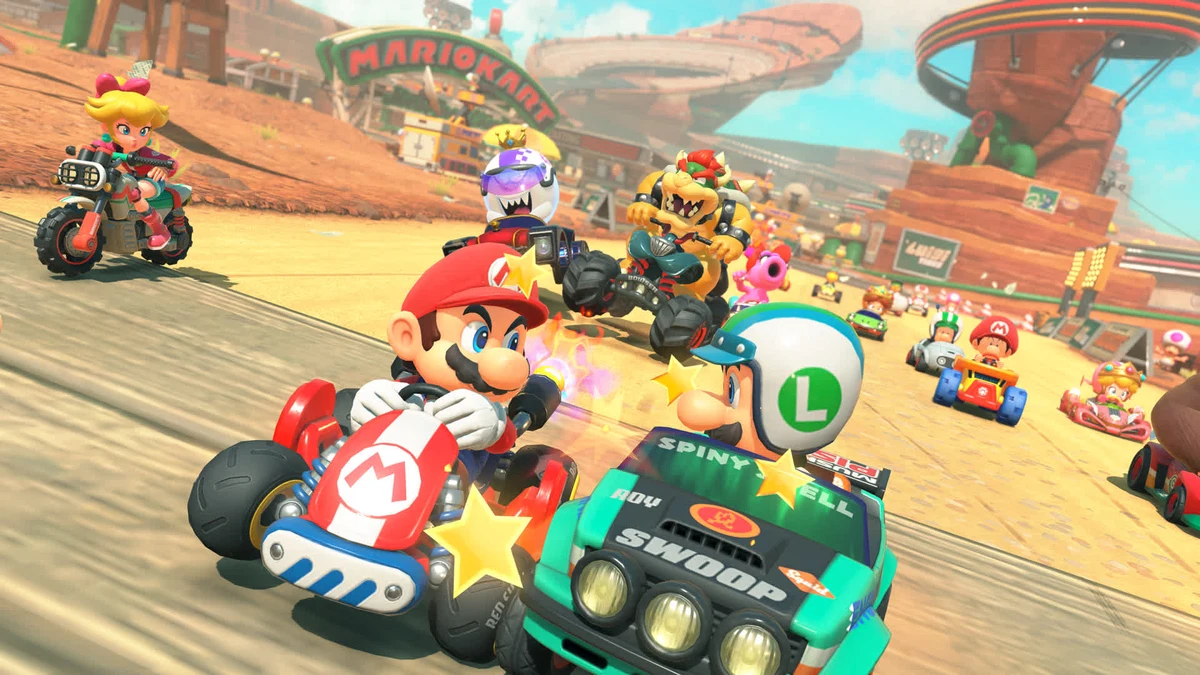
Picking the right character and vehicle combination is one of the few genuinely strategic decisions you make before every race in the Mario Kart series, and the systems behind it have changed significantly between Mario Kart 8 Deluxe and Mario Kart World. Understanding how stats actually work in each game will help you build something suited to your play style instead of just picking whoever looks coolest.
The core stats that matter
Across both games, character and vehicle choice affects a shared set of core stats: Speed determines your top velocity on straightaways, Acceleration governs how quickly you regain speed after slowing down, a crash, or an item hit, Weight influences how easily you can bump smaller racers off the road and how much you are affected when bumped yourself, and Handling controls how tightly you can turn and how easily you steer through curves. In Mario Kart 8 Deluxe, additional substats like traction and mini-turbo also come into play depending on your parts, while Mario Kart World keeps the presentation more streamlined around the same four core numbers.
How character weight classes work
Both games organize characters into weight classes, generally ranging from lightweight to heavyweight, and your class has a direct effect on your stat spread. Lighter characters such as Toad or Baby Mario tend to have higher acceleration and handling but lower top speed and weight, making them easier to control but easier to knock around. Heavier characters such as Bowser or Morton trade that agility for a higher top speed and much greater weight, letting them barrel through smaller racers with far less risk of being knocked off course themselves. In Mario Kart World specifically, character classes are typically grouped into tiers such as Feather, Light, Medium, and Heavy, with example stat spreads showing lighter characters like Bowser Jr., Daisy, and Peach around 1.8 speed, 2.4 acceleration, 1.6 weight, and 2.2 handling, versus a more balanced spread of 2.0 speed, 2.2 acceleration, 1.8 weight, and 2.0 handling for characters like Mario, Luigi, and Pauline.
Kart customization in Mario Kart 8 Deluxe
If you are playing Mario Kart 8 Deluxe, full kart customization is intact and central to building a strong racer. You choose a body, tires, and glider independently, and each part nudges your overall stats in different directions. Lightweight bodies paired with roller tires tend to maximize acceleration and handling for tight, technical tracks, while heavier bodies with slick tires push top speed higher for tracks with long straights. Because parts and characters combine additively, experienced players often build around a specific stat target, for example pairing a heavy character with acceleration-focused parts to smooth out that character’s biggest weakness, rather than just stacking speed on speed.
Why Mario Kart World changed the customization system
Mario Kart World takes a notably different approach: traditional part-by-part kart customization has been removed entirely. Instead of assembling a build from separate body, tire, and glider components, players choose from a large roster of premade vehicles, each with its own fixed, predetermined stat profile visible on the selection screen. With 40 total vehicles, including 21 karts, 11 bikes, six trikes, and two unconventional “mobiles,” and dozens of playable characters, the game still offers thousands of character-vehicle combinations, but the way you reach a build is different: you are selecting a whole vehicle for its stat identity rather than tuning individual parts.
This shift moves the customization emphasis toward character and vehicle selection rather than mechanical tuning. In place of stat-tuning parts, Mario Kart World leans on cosmetic stickers, decals earned by completing objectives, that let players personalize the appearance of their vehicle without touching its underlying performance. Some stickers are unlocked from the start, while the vast majority are earned through Free Roam activities like P Switch missions, collecting Peach Medallions, and activating ? Panels.
Building around your play style
Once you understand the stat system, building a combo is mostly about matching a profile to how you actually play. If you struggle to stay on the road after item hits or tight corners, prioritize handling and acceleration over raw top speed, since a fast character who is constantly spinning out or falling behind after collisions will lose more time than they gain on straightaways. If you play aggressively and like bumping opponents off narrow tracks, a heavier build with strong weight stats will let you win those collisions consistently. Players who focus on time trials and clean laps, where crashes are rare, tend to benefit most from pure speed and handling combinations since acceleration and weight matter less when nobody is bumping into you.
Matching your build to the track
Track design should influence your choice as much as raw stats do. Long, open circuits with wide straights reward speed-focused builds, since there is more room to hit and hold a high top speed. Tighter, more technical courses with sharp corners and obstacles favor acceleration and handling, since you will be constantly slowing down and needing to recover quickly. In Mario Kart World, this same logic extends to the open-world sections connecting tracks in Grand Prix and Knockout Tour, where you may be navigating varied terrain rather than a single consistent track type, so a more balanced, medium-class build is often a safer default than an extreme min-max setup.
If you want a broader overview of every character, mode, and mechanic across the franchise before diving into stat optimization, check out our complete Mario Kart guide.
A simple starting recommendation
For newer players in either game, a medium-weight character paired with a balanced vehicle is the easiest way to avoid the downsides of extreme builds while you are still learning tracks and item timing. Once you have logged enough races to know where you are losing time, whether it is slow recovery after hits, sluggish top speed on straights, or getting bumped off course too easily, you can shift toward a more specialized speed, acceleration, or weight-focused combination that directly addresses that weakness.