Minecraft seeds are the single easiest way to skip the boring part of starting a new world and land somewhere genuinely interesting. A good seed can drop you next to a village stocked with a blacksmith chest, a mountain riddled with exposed ore, or an ancient city close enough to raid without a days-long trek through the deep dark. This list covers seeds that hold up on the current 26.x update line — the year-based version system Mojang moved to in 2026 — for both Java and Bedrock Edition. If you’re brand new to the game and want the fundamentals before you start seed-hunting, our Minecraft beginner’s guide is the better starting point; come back here once you’re ready to pick your world.
How Minecraft Seeds Work (and Why They Matter More in 2026)
A seed is the number (or text string) that determines every detail of a world’s generation — terrain, biomes, structures, cave systems, all of it. Enter the same seed on the same version and platform, and you’ll generate an identical world every time. The catch is that “same version” matters. Minecraft’s world generation has changed meaningfully over the years — the underground got a total overhaul with caves and cliffs, ancient cities and trial chambers were added later, and 26.2 introduced the sulfur caves biome — so a seed screenshot from an old article might not line up exactly with what you see on the current build. Surface terrain and named structures near spawn are generally stable across recent versions, but deep underground layouts can shift slightly as new cave biomes get folded into the generation rules. If a structure listed below is off by a few dozen blocks from what you find, that’s almost always why.
Also worth knowing: Java and Bedrock use different world generation algorithms, so the same seed number can produce a noticeably different world on each platform. The seeds below are generally strong on both, but always double-check biome and structure locations after loading in.
Best Seeds for a Strong Survival Start
These seeds prioritize a smooth early game: villages for free food and gear, easy resources, and a safe-ish spawn.
| Seed Type | Seed Code | What You’ll Find |
|---|---|---|
| Survival island villages | 2218715947278290213 | Multiple villages clustered close together across island terrain — great for trading and mob farms early |
| Taiga village hub | 2990297396645658645 | Taiga village at spawn, a ruined portal merged into a house, and a trial chamber directly underneath |
| Plains village mega-hub | 9137002542963915989 | Plains village near spawn with accessible trial chambers and an ancient city within reach — a strong late-game base location too |
| All biomes nearby | 4405134068028 | Wide biome variety within a short walk of spawn, useful if you want quick access to every wood type and biome-specific mob |
Best Seeds for Rare and Unique Terrain
If you’re after screenshots or just want a dramatic base location, terrain-focused seeds are worth generating specifically for their landscape rather than resources.
- Incredible Hollow Mountain (8486672581758651406): Spawns you near a massive mountain riddled with natural caverns and overhangs, ideal for a mountainside base built into exposed stone.
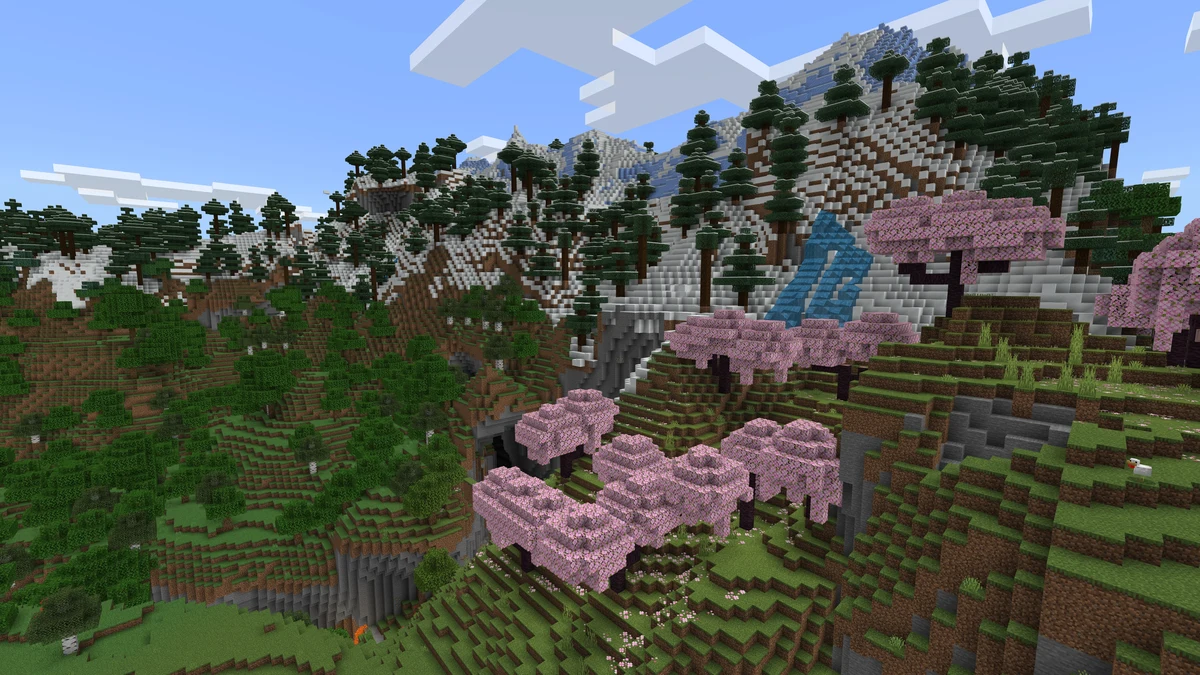
- Cherry Blossom Biome (1861965201489179097): Puts a cherry grove — one of the more visually distinct biomes — within easy reach of spawn, great for a pink-and-white aesthetic build.
- Diamond Caves (4361528937055201680): A dense, sprawling cave network with unusually visible ore veins close to the surface, good for players who want to mine without descending too far.
- Underwater Temple (1013382714437321718): Spawns near an ocean monument, letting you gear up for a guardian farm early instead of stumbling onto one hours into a playthrough.
Best Seeds for Ancient City and Deep Dark Hunters
Ancient cities remain some of the most dangerous and rewarding structures in the game, guarded by the Warden and packed with loot like echo shards and disc fragments. These seeds put one within reach without an extensive search:
- Ancient City Near Spawn (4189766944005904899): A short walk or boat ride from spawn to a full ancient city, letting you gear up and dive in without a multi-day expedition.
- Taiga village hub (2990297396645658645) and Plains village mega-hub (9137002542963915989), both listed above, also include ancient cities within reasonable range of their village spawns, which makes them efficient picks if you want both a home base and a deep dark expedition without generating two separate worlds.
Bring muffled boots (leather boots enchanted with Swift Sneak, found on trial chamber ominous vaults) before attempting a serious ancient city loot run — the Warden detects sound and vibration, not just sight.
Best Seeds for Builders and Screenshot Hunters
Not every seed needs to be efficient. Some are just worth generating because the terrain is unusual:
- Look for seeds combining mountain peaks with meadows for varied elevation in a build.
- Mushroom island seeds remain some of the rarest and most striking biomes to build on, since hostile mobs can’t spawn there naturally.
- Badlands-and-savanna transition zones give a strong orange-and-green palette that photographs well for showcase builds.
Because exact mushroom island and badlands seed codes shift slightly between versions, your safest bet is generating a fresh world on your current version and scouting with an in-game map before committing to a base location.
Best Seeds for Speedrunners and Efficient Starts
Speedrun-friendly seeds aren’t about pretty terrain — they’re about minimizing travel time to key resources: a village for early gear, a nearby Nether portal opportunity, and short distances between the overworld goals and the stronghold. The survival-hub seeds listed earlier in this guide double well here, since a village plus a nearby trial chamber or ancient city means you can gear up fast without wasting real-world minutes on empty biomes.
If you’re speedrunning seriously rather than casually, most of the competitive community treats seeds as off-limits anyway, since official runs are typically done on randomly generated worlds to keep results comparable. Pre-picked seeds are really a practice tool here — great for drilling a specific route (bastion-to-stronghold, for example) over and over without re-learning a new world layout every attempt.
A Note on Seed Longevity After Game Updates
One thing worth flagging for anyone bookmarking a seed for the long term: new biomes added in future drops — like the sulfur caves introduced in 26.2 — generate into the previously unexplored parts of a world, not retroactively into chunks you’ve already loaded. That means if you started a world on an older version and update later, your near-spawn terrain won’t suddenly grow a sulfur cave underneath your base, but unexplored regions further out will include it. This is normal chunk generation behavior rather than a bug, and it’s a good reason to keep exploring outward in a long-term world instead of assuming everything nearby has already generated.
How to Enter a Seed (Java and Bedrock)
On Java Edition, select “Create New World,” open “More World Options,” and paste the seed number into the Seed field before generating. On Bedrock Edition, the option appears under “Game” settings when creating a new world — toggle it open and enter the same numeric code. Both platforms accept text seeds too (Minecraft converts any text you type into a numeric seed internally), but for guaranteed matches with a specific listed world, stick to the exact numeric code.
Frequently Asked Questions
Q: Do seeds work the same on every Minecraft version? Mostly, but not perfectly. Major world generation updates can shift terrain, especially underground, so a seed documented on an older version may look slightly different on the current 26.x build. Structures near spawn tend to be the most stable.
Q: Can I use a Java seed on Bedrock, or vice versa? You can enter the same numeric seed on both, but the two editions use different generation algorithms, so expect a different — sometimes very different — world.
Q: What’s the best seed for finding diamonds fast? Cave-focused seeds like the Diamond Caves seed above help, but in general, mining between Y-level -64 and -54 on any seed is the more reliable strategy long term.
Q: Are seed codes safe to share or use from random websites? Yes — a seed code is just a number that generates a world locally on your own game; it can’t carry malware or affect your save files beyond generating that specific world.
Q: How do I find my own seed if I already started a world? Type /seed in chat (with cheats enabled) on Java, or check the world’s settings menu on Bedrock.
The Bottom Line
A great seed won’t play the game for you, but it removes a lot of the early friction — no more spawning in the middle of an ocean with nothing but sand for a mile. Pick one of the survival-friendly options above if you want a smooth start, or go terrain-hunting if you’re building for looks. Once you’ve settled into a world, check our complete Minecraft guide for everything else worth knowing about the current update, and pair a good seed with a few essential mods from our best Minecraft mods list if you want extra tools for exploring it.