Table of Contents
- What Is Mobile Legends: Bang Bang?
- The Map: Lanes, Jungle, and Objectives
- Hero Roles Explained
- The Hero Roster
- Items, Builds, and Battle Spells
- Game Modes Beyond Ranked
- The Ranked System: Warrior to Mythical Immortal
- In-Game Economy: Battle Points and Diamonds
- The Esports Scene: MPL and the M Series
- Platforms and How to Play
- Critical Reception and Controversy
- Player Base and Regional Popularity
- Tips for New Players
- Who Mobile Legends Is For
- FAQ
- Conclusion
- External Authority Sources
Few mobile games have reshaped a region’s gaming culture the way Mobile Legends: Bang Bang has reshaped Southeast Asia’s. Developed and published by Moonton, a studio now under ByteDance, the free-to-play 5v5 MOBA launched on Android on July 14, 2016 and on iOS that November, and it has since become one of the most downloaded competitive mobile games in history, with lifetime installs reported in the billions across more than 130 countries. In the Philippines, Indonesia, Malaysia, Myanmar, and Cambodia in particular, Mobile Legends is not a niche hobby — it is a mainstream pastime with televised tournaments, celebrity fan bases, and prize pools that rival PC esports. This guide breaks down everything a new or curious player needs to know: how matches actually work, what each hero role does, how the ranked ladder is structured, how the free-to-play economy functions, and how the professional scene built around events like the M Series World Championship operates. Whether you are downloading the game for the first time or trying to make sense of terms like “jungle,” “Mythical Glory,” or “Battle Points,” this article is built to be the single resource you need.
What Is Mobile Legends: Bang Bang?
Mobile Legends: Bang Bang, commonly abbreviated MLBB, is a multiplayer online battle arena (MOBA) game designed specifically for touchscreen devices. Two teams of five players each control a single hero and compete to destroy the opposing team’s base, known as the Nexus, while defending their own. Matches typically last between 10 and 20 minutes, considerably shorter than the 30-to-45-minute matches common on PC MOBAs like League of Legends or Dota 2, which is a large part of why the format translates so well to mobile play sessions.
The game is free to download and free to play, monetized through cosmetic skins, hero unlocks, and battle passes rather than pay-to-win mechanics that directly affect combat power. Players select a hero before each match, either from a roster they have permanently unlocked or from a rotating free-to-try pool, then queue into Classic mode, Ranked mode, or a variety of rotating special modes. Controls are built around a virtual joystick for movement and tap-based ability buttons, with an auto-attack and auto-aim assist system that lowers the mechanical barrier to entry compared to PC MOBAs that rely on precise mouse clicks.
The Map: Lanes, Jungle, and Objectives
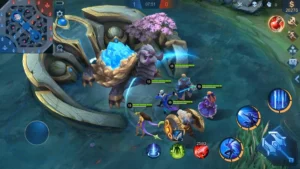
Mobile Legends is played on a single standard map, mirrored for each team, divided into three lanes: top (often called the exp lane), middle (mid lane), and bottom (also called the gold lane or farm lane). Each lane is defended by a series of turrets that must be destroyed in sequence before a team can push toward the enemy base, and each lane connects to the jungle, the open terrain between lanes filled with neutral monster camps.
The jungle is where junglers and roaming supports earn extra gold and experience by clearing monster camps, and it is also home to the map’s two most important neutral objectives:
- The Turtle (Turtle Shell / Crimson Turtle): A neutral monster that spawns periodically in the river area. Killing it grants the entire team a burst of bonus gold and a temporary shield, making it a key early-to-mid game skirmish point.
- The Lord (Lord/Baron equivalent): A far more powerful neutral monster that spawns later in the match. Once defeated, the Lord transforms into a siege unit that follows a chosen hero and helps demolish enemy towers, often serving as the catalyst for a game-ending push.
Beyond these, players fight over turrets, the enemy jungle, and vision control using wards, since destroying towers grants gold and opens direct lanes to the enemy base and, eventually, the Nexus. Team fights typically cluster around the river, the turtle and lord pits, and contested turret zones, and reading the map’s objective timers is one of the clearest signs of an experienced Mobile Legends player.
Hero Roles Explained
Every hero in Mobile Legends belongs to one or more of six roles, and understanding these roles is the foundation of learning to draft a team and play your position effectively.
Tank heroes are built to absorb damage, initiate fights, and protect teammates. They typically build items with high HP, armor, and magic resistance, and their kits usually include crowd control abilities like stuns, knock-ups, or displacement effects. Tanks are usually assigned to the top lane or roam between lanes to set up ganks.
Fighter heroes are durable, versatile damage dealers who can hold their own in extended fights while still contributing meaningful damage output. They often serve as a team’s frontline alternative to a dedicated tank and are flexible enough to lane top, jungle, or occasionally roam.
Assassin heroes specialize in burst damage and mobility, designed to eliminate priority targets — usually enemy mages or marksmen — quickly before retreating or dying in the attempt. Assassins typically farm the jungle and look for opportunities to gank other lanes once they hit key power spikes.
Mage heroes deal magic damage through skills rather than basic attacks and usually occupy the mid lane. Mages range from burst-oriented heroes that can eliminate squishy targets in a single combo to sustained damage dealers that shine in extended team fights.
Marksman heroes (also called Marksmen or ADCs in broader MOBA terminology) are the primary source of sustained physical damage in the late game, relying on basic attacks empowered by item builds. Marksmen are typically weak early and require careful protection, farming safely in the gold lane before scaling into a team’s main damage carry.
Support heroes prioritize keeping their team alive and enabling carries over dealing damage themselves, using heals, shields, buffs, and vision-granting items. Supports usually pair with the marksman in the bottom lane during the early game before roaming to assist other lanes.
Most drafts settle into a familiar shape: one tank, one fighter or offlaner in the top lane, one mage in the mid lane, one marksman and one support paired in the bottom lane, and a jungler drawn from the fighter or assassin pool. Because several heroes are flexible across multiple roles, draft strategy and role assignment remain a meaningful skill layer even at high ranks.
The Hero Roster
Mobile Legends launched with a modest roster and has expanded it continuously for roughly a decade, with Moonton regularly releasing new heroes alongside balance patches and hero reworks. By 2026 the roster has grown to well over 120 heroes, with figures reported in the range of 125 to 133 depending on the exact patch and server measured, making it one of the largest active hero pools of any MOBA on any platform.
Heroes are organized not only by role but by a secondary “specialty” tag — such as Damage, Poke, Burst, Charge, Guard, Push, Support, or Control — that further refines how a given hero is meant to be played within their broader role. This layered classification system means two heroes sharing the same primary role, such as two Fighters, can play in meaningfully different ways: one might excel at sustained team fighting while another specializes in split-pushing lanes alone.
New heroes are typically released alongside a themed lore event tying into the game’s ongoing narrative, the Land of Dawn, and are often accompanied by premium skins as part of Moonton’s monetization strategy. Established heroes are periodically reworked to keep the roster balanced as the game’s competitive meta evolves, and Moonton publishes regular patch notes detailing hero adjustments, new items, and map or system changes.
The roster spans a wide range of design philosophies within each role. Early, foundational heroes such as Tigreal (Tank), Alucard (Fighter), Layla (Marksman), and Eudora (Mage) remain part of the free hero rotation cycle that all players, regardless of spending, can regularly access, making them common entry points for beginners still learning role fundamentals. More recent additions tend to have more intricate skill kits, resource systems, or stance-switching mechanics, reflecting a decade of iterative design as Moonton has worked to keep the game mechanically fresh without alienating its enormous existing player base. This mix of simple, accessible early heroes and increasingly complex newer releases is one reason Mobile Legends can serve both first-time MOBA players and veterans chasing mechanical mastery on the same client.
Items, Builds, and Battle Spells
Beyond hero selection, item builds are the second major layer of strategic decision-making in every Mobile Legends match. Each hero can equip six item slots during a match, purchased with in-match gold earned from farming minions, jungle camps, objectives, and kills. Items are broadly split into physical damage, magic damage, defensive, and movement categories, and most experienced players adjust their build in real time based on the enemy team’s composition rather than following a single fixed sequence for every game.
Common defensive items grant health, armor, or magic resistance along with a passive or active effect, such as a damage-reduction shield or a burst heal, while offensive items scale a hero’s basic attacks or ability power and often carry unique passives like bonus true damage or lifesteal. Boots are a required early purchase for every hero, providing movement speed with a choice of secondary effects such as tenacity against crowd control or bonus mana regeneration.
Alongside items, every hero equips one Battle Spell before a match starts — a powerful, cooldown-based ability separate from the hero’s own kit, such as Flicker (a short-range blink), Execute (bonus damage to low-health enemies), Purify (removes crowd control effects), or Flame Shot (a ranged damage burst). Players also select an Emblem set and allocate emblem talent points, which grant small passive stat bonuses tailored to a role, such as extra physical attack for Marksman-focused emblems or extra tankiness for Tank-focused emblems. Together, item builds, battle spells, and emblems give players meaningful build customization on top of hero and role selection, and mastering these systems is typically what separates a strong intermediate player from a beginner who only understands hero mechanics in isolation.
Game Modes Beyond Ranked
While Ranked mode gets most of the competitive attention, Mobile Legends offers several other modes that serve different purposes for different types of players.
Classic Mode is the standard 5v5 game with no rank stakes, matchmaking players of similar skill without affecting their season rank. It is the primary place to learn a new hero, test an unfamiliar build, or simply play a relaxed match, and Moonton generally recommends new players spend meaningful time here before entering Ranked queues.
Brawl Mode strips the map down to a single lane with a simplified jungle, delivering faster, more chaotic 5v5 matches for players who want shorter sessions focused purely on team fighting rather than lane management and macro strategy.
Mayhem Mode and other rotating limited-time modes periodically introduce altered rulesets, such as enhanced hero abilities, unusual starting conditions, or novel win conditions, giving the existing hero roster a fresh feel without requiring new content development.
Arcade Mode functions as an umbrella category for special, often narrative or event-themed modes tied to in-game seasonal events, frequently rewarding Battle Points, event currency, or exclusive cosmetic items for participation rather than being built around competitive balance.
Custom Games allow players to set up private matches with friends, adjustable rules, and controlled team compositions, commonly used by scrimmaging esports teams, content creators running community matches, and friend groups practicing specific strategies outside of standard matchmaking.
This spread of modes is part of why Mobile Legends has sustained such a broad audience: competitive players have Ranked and Custom Games to hone their craft, while casual players have Classic, Brawl, and rotating Arcade content to enjoy the game without the pressure of a season-long rank to protect.
The Ranked System: Warrior to Mythical Immortal
Mobile Legends’ ranked mode is the primary long-term progression system for competitive players, structured as a ladder of tiers that must be climbed sequentially. As of 2026, the ranked tiers, from lowest to highest, are:
- Warrior
- Elite
- Master
- Grandmaster
- Epic
- Legend
- Mythic
- Mythical Honor
- Mythical Glory
- Mythical Immortal
Each of the lower tiers (Warrior through Legend) is divided into sub-divisions that players climb using a star system: winning a ranked match earns stars, and losing deducts them, with a set number of stars required to fill a division before promoting to the next. The star requirement per division tightens as players climb — for example, Warrior to Elite generally requires three stars per division, while Master to Legend requires four — and higher tiers introduce protection mechanics that prevent players from losing an entire division’s progress on a single defeat.
Mythic rank functions differently. Rather than divisions, it uses a continuous points ladder: players enter Mythic and accumulate points toward Mythical Honor at roughly 25 points, Mythical Glory at roughly 50 points, and the top tier, Mythical Immortal, at 100 or more points. Mythical Glory in particular has become the game’s benchmark for a genuinely skilled player, roughly analogous to Master or Grandmaster tiers in other competitive online games, while Mythical Immortal represents the top slice of the ranked population and is where the leaderboard-chasing elite compete each season.
Ranked seasons reset periodically, softening top ranks back down and giving the entire player base a reason to climb again, while placement and calibration matches at the start of each season help settle players into an appropriate starting tier based on recent performance.
In-Game Economy: Battle Points and Diamonds
Mobile Legends runs on a dual-currency economy designed to separate free progression from premium spending, and the two currencies do not convert into one another.
Battle Points (BP) are the free, grindable currency earned primarily by playing matches in Classic, Ranked, or Arcade modes. Additional Battle Points come from daily login rewards, completing missions and quests, opening reward chests, selling unused heroes or items from your inventory, participating in in-game events, and using consumable items like the Double BP Card, which temporarily doubles match earnings. Moonton has, in past patches, capped the maximum weekly Battle Points obtainable from matches to keep the economy balanced. Battle Points are used primarily to purchase heroes, meaning a patient free-to-play player can unlock the entire roster over time without spending money.
Diamonds are the premium currency, purchased with real money through the in-app store, and they unlock cosmetic skins, exclusive heroes on release, battle pass tiers, and other premium content. Free Diamonds are attainable in smaller amounts through limited-time events, contests, daily missions, and weekly supply tasks that occasionally convert milestone rewards into Diamonds, but the bulk of the Diamond economy is built around direct purchases and the game’s recurring battle pass system.
This structure means Mobile Legends is free-to-play in the fullest sense for hero access and core competitive progression — ranked matchmaking is not gated by spending — while cosmetics, convenience, and collection remain the primary revenue drivers, consistent with how most successful live-service mobile MOBAs monetize.
The Esports Scene: MPL and the M Series
Mobile Legends supports one of the largest competitive ecosystems in mobile esports, anchored by two structures: national professional leagues and the international M Series World Championship.
MPL (Mobile Legends: Bang Bang Professional League) is the umbrella brand for Moonton’s regional professional leagues, with flagship competitions in Indonesia (MPL ID), the Philippines (MPL PH), and Malaysia/Singapore (MPL MY/SG), alongside additional regional circuits established as the game expanded. MPL Indonesia became the first franchised esports league in Southeast Asia in 2019, and MPL Philippines adopted a franchised model of its own a couple of seasons later, replacing open qualification with a fixed set of franchise organizations competing across multiple seasons per year. These leagues run structured regular seasons followed by playoffs, and their top teams qualify for international events.
The M Series World Championship, often called “M Worlds” and numbered sequentially (M1, M2, and so on), is Mobile Legends’ premier international tournament, bringing together the top teams from qualifying regions around the world. The M7 World Championship, held in Jakarta in January 2026, carried a $1 million prize pool, with $320,000 awarded to the champion, $150,000 to the runner-up, $90,000 for third place, and a separate $5,000 MVP award. The tournament format brought together 22 teams across a Wildcard Stage, a Swiss Stage, and a Knockout Stage culminating in the Grand Finals. Philippine teams have been especially dominant on the international stage, having won the majority of M Series titles since M2 in 2021, a track record that has made the Philippines widely regarded as the strongest competitive region in Mobile Legends esports. The Mid-Season Cup (MSC) serves as a secondary annual international event held between M Series championships, giving qualifying teams another marquee international stage. Mobile Legends has also featured in broader multi-title events such as the Esports World Cup, reflecting its growing status within the wider esports industry rather than as a regional curiosity alone.
Platforms and How to Play
Mobile Legends: Bang Bang is available as a free download on both the Apple App Store for iOS devices and the Google Play Store for Android devices, and it also runs through Huawei AppGallery and other regional Android app storefronts in markets where Google services are restricted. The game supports cross-platform play between iOS and Android within the same regional server, so friends on different device types can queue together without issue.
Players can also access the game on desktop through Moonton’s official emulator-style client and through third-party Android emulators, which many competitive and content-creating players use for more precise control using a mouse and keyboard. Progress, purchases, and account data sync through a linked Moonton account, VK, Facebook, Google, or Apple ID login, allowing players to move between a phone and an emulator without losing progress.
System requirements are modest by modern mobile gaming standards, since the game is designed to run smoothly on a wide range of budget and mid-tier Android devices as well as older iPhones, which has been a significant factor in its outsized popularity across Southeast Asia, where budget smartphones are the dominant gaming hardware.
Critical Reception and Controversy
Mobile Legends’ commercial success has run alongside a persistent and well-documented controversy: its close resemblance to Riot Games’ League of Legends. Riot Games sued Moonton (through its Shanghai-based entity) on more than one occasion, alleging that Mobile Legends copied assets, hero designs, and promotional materials, and that Moonton’s later logo redesign closely mirrored League of Legends’ own 2019 rebrand. Both major suits, filed in United States courts, were ultimately dismissed on jurisdictional grounds, with judges ruling that the disputes were more appropriately handled in Chinese courts rather than resolving the underlying plagiarism claims on their merits. The controversy has not meaningfully slowed the game’s growth, but it remains a frequently cited criticism in coverage of the title and a point of tension within the broader MOBA community.
Player-facing criticism tends to focus on different issues: inconsistent matchmaking quality, an at-times toxic in-game chat environment common to many competitive online games, and aggressive monetization tactics around limited-time skins and events. At the same time, the game is broadly credited within the mobile gaming industry for popularizing the MOBA genre on touchscreens, refining a control scheme that other mobile MOBAs have since imitated, and sustaining one of the most active esports scenes in mobile gaming for close to a decade. Its longevity and continued content cadence — regular hero releases, map and system updates, and a packed annual esports calendar — are generally treated as evidence that Moonton has built a durable live-service product regardless of its contested origins.
Player Base and Regional Popularity
Mobile Legends is one of the most-installed mobile games in the world, with lifetime installations reported in the billions across more than 130 countries as of early 2026. Monthly active user figures vary depending on the source and measurement method: Moonton’s own reporting has cited well over 100 million monthly active users, a figure that includes players on third-party Android app storefronts not captured by Google Play or App Store analytics tools, while independent trackers relying on official storefront data have reported narrower figures in the tens of millions, with notable spikes coinciding with major esports events like the M Series World Championship.
Regardless of which measurement is used, the game’s core strongholds are consistent: the Philippines, Indonesia, Malaysia, Myanmar, Cambodia, and other Southeast Asian markets, where Mobile Legends functions as something closer to a national pastime than a niche game. It has also built meaningful player bases in Latin America, the Middle East and North Africa, and parts of Eastern Europe and Central Asia, aided by low device requirements and Moonton’s continued investment in region-specific servers, localized esports leagues, and marketing.
Tips for New Players
Getting started in Mobile Legends is straightforward, but a handful of habits separate players who climb the ranked ladder from those who plateau early. Most of these habits have less to do with mechanical skill and more to do with decision-making, positioning, and understanding the map as a shared resource rather than a backdrop for individual kills.
- Pick a role and a small hero pool first. Rather than trying every hero in the roster, master two or three heroes within one role — a marksman and a mage, for example — before branching out. Deep familiarity with a hero’s cooldowns and combos matters more than roster breadth at lower ranks.
- Prioritize farming and objectives over kills. Gold from minions, jungle camps, and the turtle typically matters more for long-term win rate than aggressive early kills that leave you out of position.
- Ward and track the map, not just your lane. Many losses at low-to-mid ranks come from being caught unaware by roaming enemies rather than losing a straight lane fight.
- Use the recommended item builds as a baseline, not a rulebook. The game’s suggested builds are a reasonable starting point for new heroes, but adjusting item choices to counter the enemy team’s composition is a core part of improving.
- Play Classic mode before queuing Ranked. Classic mode carries no rank stakes and is the right place to learn new heroes, experiment with builds, and get comfortable with map rotations before matches start affecting your rank.
- Communicate through pings and the quick-chat wheel. Mobile Legends’ ping and quick-chat system is fast and effective; using it consistently to call missing enemies, request help, or signal objective timing measurably improves coordination even with strangers.
- Learn the turtle and lord timers. Knowing roughly when these objectives respawn and contesting them as a team, rather than as individuals, is one of the clearest jumps in strategic play between beginner and intermediate ranks.
- Retreat when you are behind on cooldowns. New players frequently die by re-engaging fights immediately after using their key abilities. Tracking your own cooldowns as closely as the enemy’s is a habit that pays off at every rank.
- Watch replays of your losses. Mobile Legends stores match history and battle reports that show gold graphs, damage dealt and taken, and key events. Reviewing a loss for positioning mistakes or missed objective calls is one of the fastest ways to improve outside of match time itself.
Who Mobile Legends Is For
Mobile Legends is best suited to players who want the strategic depth of a MOBA — drafting, lane assignments, objective control, team fighting — without the 30-to-45-minute time commitment that PC MOBAs typically demand. Its short match length, touchscreen-native controls, and free hero access through Battle Points make it especially approachable for players new to the genre, while its deep hero roster, layered role and specialty system, and demanding ranked ladder give experienced competitive players plenty of room to specialize and improve. It is a natural fit for players who already enjoy team-based competitive games and want something playable in short sessions on the move, and it holds particular cultural relevance for players connected to Southeast Asia’s gaming and esports scene, where the game’s professional leagues and international tournaments draw broadcast-level audiences. Players who strongly dislike free-to-play monetization models or competitive toxicity common to ranked online games should go in with realistic expectations, since both are recurring themes in player feedback.
FAQ
Is Mobile Legends: Bang Bang free to play? Yes. The game is free to download on iOS and Android, and core competitive progression, including hero unlocks through Battle Points and full access to ranked matchmaking, does not require spending money. Diamonds, the premium currency, are used mainly for cosmetic skins and convenience purchases rather than combat-affecting upgrades.
How many heroes are in Mobile Legends? The roster has grown continuously since 2016 and stood at well over 120 heroes as of 2026, with reported figures in the range of 125 to 133 depending on the specific patch and server measured. Moonton adds new heroes on a regular ongoing schedule.
What is the highest rank in Mobile Legends? Mythical Immortal is the highest rank, reached by accumulating 100 or more points within the Mythic point ladder, above Mythic, Mythical Honor, and Mythical Glory. Below Mythic, the tier order runs Warrior, Elite, Master, Grandmaster, Epic, and Legend.
What is the difference between Battle Points and Diamonds? Battle Points are earned for free by playing matches and completing missions, and are used mainly to purchase heroes. Diamonds are the premium currency purchased with real money and are used mainly for skins, battle passes, and other cosmetic content. The two currencies do not convert into each other.
What is the M Series World Championship? The M Series, or M Worlds, is Mobile Legends’ premier annual international tournament, bringing together the top teams from regional professional leagues around the world. The M7 World Championship took place in Jakarta in January 2026 with a $1 million prize pool, and Philippine teams have won the majority of M Series titles since M2 in 2021.
Is Mobile Legends similar to League of Legends? Mobile Legends shares core MOBA structure with League of Legends — three lanes, a jungle, turtle and lord objectives comparable to Dragon and Baron, and similar hero role archetypes. Riot Games has sued Moonton more than once alleging Mobile Legends copied elements of League of Legends, though the U.S. lawsuits were dismissed on jurisdictional grounds rather than decided on the underlying claims.
Can I play Mobile Legends on PC? Yes. Moonton offers an official desktop client that mirrors the mobile experience with mouse-and-keyboard controls, and many players also use third-party Android emulators. Accounts sync across devices through a linked Moonton account or a connected Google, Apple, Facebook, or VK login, so progress carries over regardless of which device you play on.
Conclusion
Mobile Legends: Bang Bang earned its place as one of the defining mobile esports titles of the past decade by taking the core MOBA formula — lanes, a jungle, objective-based team fighting, and a deep hero roster split across clear roles — and compressing it into matches that fit into a commute or a lunch break, without stripping out the strategic depth that makes the genre compelling. Its free-to-play economy, built around the Battle Points and Diamonds split, keeps competitive progression accessible while still funding a decade of continuous content updates and one of the richest esports ecosystems in mobile gaming, anchored by the MPL regional leagues and the M Series World Championship. The plagiarism controversy tied to League of Legends is a real and recurring part of its story, but it has not stopped Mobile Legends from becoming the default competitive mobile game across large parts of Southeast Asia and a growing presence well beyond it. For players weighing whether to pick it up, the practical case is straightforward: modest device requirements, a genuinely free path to the full hero roster, short matches, and a ranked ladder with enough depth — from Warrior all the way to Mythical Immortal — to hold a competitive player’s attention for years.
External Authority Sources
- Mobile Legends: Bang Bang – Wikipedia
- Mobile Legends: Bang Bang World Championship – Wikipedia
- Riot Games sues Mobile Legends: Bang Bang maker – PC Gamer
- MPL Philippines – Liquipedia Mobile Legends: Bang Bang Wiki