
Table of Contents
- What Is Sea of Thieves?
- Sailing and Ship Mechanics
- Ship Types and Crew Roles
- Trading Companies and Factions
- Voyages: PvE Adventures on the High Seas
- Tall Tales: The Story Campaigns
- PvP: Skeleton Forts, Reaper’s Bones, and the Hourglass of Fate
- Safer Seas: Solo and PvE-Only Play
- Pirate Legend and Legends of the Sea
- Seasons and Live Content
- Cross-Platform Play and Cross-Progression
- Platforms and Xbox Game Pass
- Tips for New Pirates
- Who Is Sea of Thieves For?
- Critical Reception and Legacy
- FAQ
- Conclusion
- External Authority Sources
Few games have been rewritten as thoroughly by their own community as Sea of Thieves. Rare’s shared-world pirate adventure launched on Xbox One and Windows 10 in March 2018 as a striking but sparse sandbox: gorgeous water, satisfying sailing, and not much else to do once the initial thrill wore off. Eight years and dozens of free content seasons later, it has become one of the most complete live-service games on any platform, spanning Xbox Series X|S, Xbox One, PC, PlayStation 5, and Xbox Game Pass, with cross-play and cross-progression tying every version together into a single player base.
What makes Sea of Thieves worth revisiting in 2026 is not nostalgia, it is the sheer volume of systems now layered onto that original sailing loop. Nine-part story campaigns, a Pirates of the Caribbean crossover, a Monkey Island crossover, five rival trading companies, a solo-friendly PvE-only mode, seasonal battle passes, and an evolving PvP system have all been built on top of the same three ship types and the same open ocean. This guide breaks down every major system in the game as it exists today: how sailing and crews work, what each faction offers, how the Tall Tales story unfolds, how PvP and Safer Seas differ, and what a new or returning pirate needs to know before setting sail.
What Is Sea of Thieves?
Sea of Thieves is a shared-world, first-person multiplayer pirate adventure developed by Rare, the veteran British studio behind Banjo-Kazooie and Goldeneye 007, and published by Xbox Game Studios. It released on March 20, 2018, exclusively on Xbox One and Windows 10, arrived on Steam in June 2020, and expanded to PlayStation 5 on April 30, 2024, with a Premium edition launching five days earlier.
The game drops crews of one to four players onto a persistent, procedurally-populated ocean dotted with hundreds of islands, shipwrecks, sea forts, and outposts. There is no traditional character progression tree and no experience points tied to combat kills. Instead, players sail between islands accepting Voyages from trading companies, hunting buried treasure, fighting skeleton crews, battling other ships, fishing, and exploring, all while managing a ship that requires constant hands-on attention. Everything that happens on the sea, from a chance encounter with a rival crew to a sudden Kraken attack, occurs in real time in a shared world rather than in instanced missions.
Sea of Thieves is best understood as an immersive sim wrapped around a sandbox economy. The core sailing and combat systems have barely changed since launch; what has transformed the game is the volume of content built around them, including narrative Tall Tales, world events, seasonal rewards, and alternate play modes for solo and PvE-focused players.
Sailing and Ship Mechanics
Sailing is the mechanical heart of Sea of Thieves, and it remains one of the most tactile systems in any multiplayer game. Wind direction and speed constantly affect how a ship moves, and players must physically raise or lower sails, adjust their angle relative to the wind, and steer at the wheel to get anywhere efficiently. Sailing directly into the wind slows a ship to a crawl, while sailing with the wind at an angle can push it to full speed, so reading the wind gauge and adjusting sail angle is a skill every crew develops over time.
Navigation relies on a physical map table, a compass, and landmarks rather than a waypoint marker glued to the screen. Players plot courses by hand, cross-reference their position against known islands, and use a sextant-like process of triangulation for treasure maps that show a location without naming it. This deliberately analog approach to navigation is one of the traits critics and players alike point to as core to the game’s identity.
Combat and hazards at sea come from several directions at once. Cannon fire punches holes below the waterline that flood the hold if not patched with wooden planks, storms and waves batter the ship and can capsize an unprepared crew, and sea creatures such as the Kraken, megalodons, and the ghostly Ashen Lords can attack ships that stray into their territory. A ship that takes on too much water and is not bailed out with a bucket will sink outright, so damage control is as central to ship combat as aiming the cannons.
Ship Types and Crew Roles
Every voyage begins with a choice of ship, and the three available types scale differently with crew size, speed, and firepower.
- Sloop: A single-mast ship built for one or two players. It is the smallest and most fragile vessel in the game, but its tight turning radius and low crew requirement make it the most common choice for solo players and duos who want maneuverability over raw firepower.
- Brigantine: A two-mast ship that supports up to three players. It sits between the Sloop and Galleon in speed and cannon count, and is often considered the best all-around ship for small, coordinated crews since it can outrun a Galleon downwind while carrying more firepower than a Sloop.
- Galleon: The largest ship in the game, supporting one to four players across three masts and four cannons. It has the most raw firepower and cargo capacity but is the slowest to turn and the hardest to sail and defend without a full crew, since one player alone at the helm of a Galleon during a firefight is stretched thin.
There are no fixed classes in Sea of Thieves; every player can steer, fight, repair, navigate, cook, and fish regardless of the ship they are on. In practice, crews naturally divide labor based on the moment: one player might take the wheel and manage sails while another mans the cannons, a third patches leaks with wood and plugs, and a fourth watches the horizon with a spyglass or plots the next destination on the map table. On a Galleon in a pitched cannon battle, that division of labor becomes essential, since a crew that fails to bail water or patch holes will sink regardless of how well they are shooting back.
Trading Companies and Factions
Progression in Sea of Thieves runs through five Trading Companies, each offering its own style of Voyage, its own currency of reputation, and its own cosmetic rewards. Players can pledge Emissary flags to a company while sailing, which raises the value of that company’s loot the higher the flag’s grade climbs, at the cost of making the ship more visible and more valuable to attack.
- Gold Hoarders: The original treasure-hunting faction. Gold Hoarders Voyages hand out treasure maps and riddles that lead players to buried chests, and their Bounty Voyages send crews after Skeleton Captains guarding valuable Bounty Skulls on specific islands.
- Order of Souls: The bounty office of the skeleton world. Order of Souls Voyages task crews with hunting down named Skeleton Captains and their crews across the map, collecting the skulls that hold clues to hidden treasure and lore.
- Merchant Alliance: The logistics faction, focused on the safe and timely delivery of cargo. Merchant Alliance Voyages involve transporting crates of goods, fragile items, or live animals between islands and outposts without damaging or losing them along the way, rewarding careful sailing over combat.
- Reaper’s Bones: The faction built around conflict rather than delivery. Reaper’s Bones does not hand out traditional fetch Voyages; instead, it rewards players who fly its Emissary flag, the Reaper’s Mark, for engaging in PvP and turning in loot stolen from other crews, including cursed Reaper’s Chests that can be tracked on any ship’s map table once claimed.
- Hunter’s Call: The fishing and foraging faction. Hunter’s Call Voyages and reputation tasks revolve around catching specific fish species, hunting sharks and other sea creatures, and cooking meals at a ship’s cooking pot, tying into the game’s food and health system.
Reaching Level 50 with any Trading Company unlocks a rank-up promotion, and reputation with these five companies, along with the Athena’s Fortune faction unlocked later, forms the backbone of the game’s long-term progression and cosmetic economy.
Voyages: PvE Adventures on the High Seas
Voyages are the primary structured content in Sea of Thieves, purchased or accepted from Trading Company representatives at any outpost or, once unlocked, generated automatically through the Voyage Table on a player’s ship. Each Voyage type reflects its faction’s identity: Gold Hoarders send crews digging for chests marked on riddle or map-based clues, Order of Souls sends crews after specific skeleton captains, and Merchant Alliance sends crews on delivery runs that punish reckless sailing.
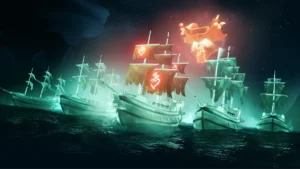
Beyond single-faction Voyages, crews can stack multiple Voyages from different companies at once, planning efficient routes that knock out a treasure dig, a bounty hunt, and a cargo delivery in the same loop around a region of the map. World Events add unscripted PvE content on top of these Voyages, including Skeleton Fleets that patrol the seas, Ghost Fleets and Ashen Lords tied to the game’s fire-themed lore, Kraken and megalodon encounters, and Sea Forts that spawn heavily defended skeleton fortresses guarding large hauls of treasure. These events are shared across the server, meaning any nearby crew can sail in and participate, or attempt to steal the loot from whoever gets there first.
Tall Tales: The Story Campaigns
Tall Tales are Sea of Thieves’ answer to a traditional story campaign, and they are where the game’s lore, characters, and set-piece design get the most room to breathe. Unlike standard Voyages, Tall Tales are hand-authored quests with scripted objectives, unique locations, voiced characters, and narrative payoffs, and they can be replayed at any time once unlocked.
The first and largest campaign is The Shores of Gold, a collection of nine Tall Tales that began releasing in April 2019 and forms the game’s original mythology, tying together the Pirate Lord, the Devil’s Shroud, and the search for the Shores of Gold itself. Taken together, the full arc represents a lengthy, multi-session story that rewards players who follow it in order.
Rare has since layered ongoing lore, sometimes referred to by the community as The Ashen Age, through seasonal Tall Tale releases and world events tied to Captain Flameheart and the Ashen Lords, expanding the game’s central conflict well beyond the original nine tales.
Two licensed crossovers sit alongside the original story. A Pirate’s Life is a five-part Tall Tale series created in collaboration with Disney, bringing Captain Jack Sparrow into Sea of Thieves and sending crews into the Sea of the Damned to confront Davy Jones, closely mirroring iconic moments from the Pirates of the Caribbean films. The Legend of Monkey Island, released in partnership with Lucasfilm Games in September 2023, is a three-part campaign that reunites players with Guybrush Threepwood and reimagines the classic adventure game’s puzzle-driven humor inside Sea of Thieves’ open world.
Tall Tales can be played solo or with a crew, do not require any prior reputation, and remain one of the best entry points for new players who want a guided introduction to the game’s world before jumping into open-ended Voyages.
PvP: Skeleton Forts, Reaper’s Bones, and the Hourglass of Fate
Player-versus-player combat in Sea of Thieves has always been optional in the sense that no Voyage forces a fight, but the shared, unsharded nature of the world means any crew can encounter, chase, or be attacked by another crew at any time on the open seas. Ship-to-ship cannon duels, boarding actions, and full-blown chest robbery are core to the game’s identity and its reputation as a tense, unpredictable pirate sandbox.
Several systems specifically funnel players toward PvP. Skeleton Forts, sometimes called Fortresses of Fortune, are heavily defended fortress islands that spawn periodically and reward the crew that clears them with a large haul of treasure, but the loot’s value and visibility on nearby map tables makes forts a magnet for other crews looking to ambush the winners rather than do the work themselves. Reaper Fortress world events specifically summon the Skeleton Lord and reward players who complete them with loot bearing the Reaper’s Mark, the cursed emissary flag tied to the Reaper’s Bones faction, which can be tracked by any other ship on the server.
Sea of Thieves originally offered a dedicated, separate PvP mode called The Arena, launched in April 2019 as part of the Anniversary Update. The Arena put competing crews on shared, contested maps in short, structured matches away from the main Adventure world. Rare stopped active development on the mode in December 2020, and after data showed only a small fraction of the player base used it regularly, the studio retired The Arena entirely on March 10, 2022.
In its place, Rare introduced an integrated, opt-in PvP system called the Hourglass of Fate, added to every ship starting with Season 8 in November 2022. Rather than sending players to a separate mode, the Hourglass lets crews on the open Adventure map voluntarily flip on PvP-focused matchmaking, aligning with one of two competing in-fiction factions, and get paired against other crews who have done the same, all without leaving the shared world. This approach folded competitive PvP back into the core sandbox rather than isolating it, addressing one of the main criticisms of The Arena’s separateness.
Safer Seas: Solo and PvE-Only Play
Not every player wants the threat of another crew showing up mid-voyage, and Rare addressed that directly with Safer Seas, a dedicated PvE-only game mode introduced in December 2023. Safer Seas places a crew on a single-crew server where no other players can appear, removing the possibility of PvP entirely while still delivering the game’s Voyages, world events, and sea creature encounters such as megalodon attacks and Ashen Lord battles.
Safer Seas was built with newer and more casual players in mind, giving them room to learn the game’s sailing, combat, and navigation systems without the pressure of a rival crew appearing on the horizon. It is also a popular way for solo players and small groups to work through Tall Tales or grind reputation at their own pace.
The mode does carry real trade-offs. Trading Company reputation on Safer Seas was originally capped and gold rewards reduced compared to the main game, known as High Seas, but starting with a December 2024 update, Rare raised Safer Seas rewards to 100 percent parity with High Seas for gold and reputation. The one progression cap that remains is a company rank ceiling of 25 rather than the full 40 available on High Seas, and the Pirate Legend title cannot be earned on Safer Seas at all, since it requires participation in the open, PvP-enabled world. Players can freely move characters and inventory between Safer Seas and High Seas at will.
Pirate Legend and Legends of the Sea
Pirate Legend is the game’s most prestigious title and the closest thing Sea of Thieves has to an end-game milestone. Earning it requires reaching Level 50 with three different Trading Companies and purchasing each company’s Level 50 promotion, then speaking to the Mysterious Stranger found in taverns across the map. Becoming a Pirate Legend grants access to the Tavern of Legends, a hidden hideout inside the wreck of the Athena’s Fortune behind a waterfall, along with the Legendary cosmetic set, the Shanty of Legends, and access to Athena’s Fortune Voyages and Legend-only Mercenary Voyages that appear during major content updates.
Separately, Rare runs Legends of the Sea, an ongoing feature that spotlights real player stories submitted from the community, ranging from remarkable rescues to legendary betrayals, alongside an in-game commendation line tied to discovering monuments and tributes to famous pirates scattered across the map. It functions as both a storytelling showcase on the official Sea of Thieves website and an in-game scavenger hunt that rewards players with unique tattoos and cosmetics for tracking down every tribute.
Seasons and Live Content
Sea of Thieves has run on a seasonal content model since Season 1 launched in January 2020, and that model has continued to evolve. Each Season introduces a Season Pass with dozens of levels of cosmetic rewards, Doubloons, Ancient Coins, and new Voyages, earned through Renown gained by completing Voyages, Tall Tales, and other in-game activities. As of Season 20 in 2026, each Season Pass spans 50 levels, delivered in sets of five that bundle currency and cosmetic rewards together.
Beginning with Season 17, Rare restructured how content rolls out within each three-month Season into a clearer three-phase cadence: the first month introduces new sandbox features and sets up the Season’s overarching theme, the second month delivers the headline live event along with story and lore expansions, and the third month focuses on revitalizing existing sandbox content to give lapsed players a reason to return. Season 20 introduced Custom Seas, a ruleset that lets players configure private server settings, and Rare has stated this ruleset will be made available to all players, free or subscriber, moving forward. The Sea of Thieves Insider Programme, a community feedback initiative, is also being relaunched in 2026 with a lifted non-disclosure agreement so participants can share more about upcoming content publicly.
Because Sea of Thieves has no subscription-gated content split from its core game, every Season’s new Voyages, Tall Tales, world events, and sandbox features are free for anyone who owns the game, with only cosmetic-focused premium currency and optional purchases sitting alongside the free track.
Cross-Platform Play and Cross-Progression
Sea of Thieves supports full crossplay across every platform it ships on: Xbox Series X|S, Xbox One, Windows PC, and PlayStation 5. A crew can be made up of players on any combination of these platforms without restriction, and matchmaking pools players together by default rather than segregating them by platform.
Cross-progression is built in as well. A player’s pirate, cosmetics, and progression are tied to their Microsoft account through Xbox Play Anywhere, meaning progress carries over between Xbox consoles and PC seamlessly. PS5 players can link their save data to continue an existing pirate started on another platform. PlayStation players do not need an Xbox Game Pass subscription to play, but they do need an active PlayStation Plus subscription to access online multiplayer, matching Sony’s standard requirement for online play on PS5. Players who prefer not to encounter others outside their own platform can disable crossplay in the settings menu, restricting matchmaking to their own platform’s population, though this reduces the pool of available public crews.
Platforms and Xbox Game Pass
Sea of Thieves is available on Xbox Series X|S, Xbox One, Windows PC through both the Microsoft Store and Steam, and PlayStation 5. It has been a day-one Xbox Game Pass and PC Game Pass title since launch in 2018, and it remains part of the Game Pass library today, making it one of the most accessible ways to try the game without a full purchase. Console and PC purchases outside of Game Pass are also available in Standard and Premium editions, with the Premium edition typically bundling extra cosmetic content.
The game’s expansion beyond Xbox has been gradual but significant: it launched on Steam in June 2020 after two years as a Microsoft Store exclusive on PC, and it arrived on PlayStation 5 in April 2024, six years after its original release, bringing it to a completely new audience of console players who had never had access to an Xbox platform. This multiplatform rollout, combined with crossplay and cross-progression, has helped the game reach a cumulative total of 40 million players across all platforms.
Tips for New Pirates
New crews consistently make the same handful of mistakes in their first few hours, and avoiding them shortens the learning curve considerably.
- Start with Tall Tales before diving into open Voyages. The Shores of Gold campaign is designed to teach core mechanics, including navigation, combat, and puzzle-solving, at a manageable pace, and it does not require any prior reputation to begin.
- Learn to read the wind gauge before worrying about combat. Sailing efficiently, adjusting sail angle, and turning through the wind rather than against it will get a crew to any destination far faster than brute-forcing a straight line.
- Keep a bucket habit. Water in the hold sinks ships faster than almost anything else in the early game; bail consistently rather than waiting until the ship is already listing.
- Use Safer Seas to learn without pressure. If ship combat or PvP anxiety is holding a new player back, Safer Seas removes the possibility of encountering hostile crews entirely while still paying out full rewards.
- Stock the ship before leaving an outpost. Cannonballs, wood, bananas, and planks run out quickly in a real fight, and outposts sell all of them cheaply before departure.
- Sell to the right vendor, not just the nearest one. Selling a Merchant Alliance crate to the Order of Souls representative, for example, will not pay out; each Trading Company only buys its own loot type unless a Reaper’s Mark Emissary flag is active, which allows selling any loot at that faction’s representative.
- Play with a mic if possible. Sea of Thieves rewards coordinated crews heavily, and a two-second callout about an incoming cannonball or a leak below deck often saves the ship.
Who Is Sea of Thieves For?
Sea of Thieves is built for players who enjoy emergent, unscripted multiplayer moments more than tightly scripted single-player campaigns, and who are comfortable with a game that can turn from peaceful fishing to a desperate firefight in seconds. It rewards groups of friends who want a shared activity to hang out around rather than a competitive shooter, and its low barrier to entry, no classes, no complex skill trees, no mandatory grind, makes it approachable for players who do not usually play multiplayer games together.
It is less suited to players who want a guaranteed, predictable single-player story from start to finish, since the game’s best moments come from unplanned encounters with other crews and its narrative content, while substantial, is optional and spread across many hours of open-world sailing. Players who dislike the possibility of losing hard-earned loot to another crew may want to start on Safer Seas rather than the open High Seas, at least until they are comfortable with the game’s systems. Solo players are well supported thanks to AI crewmate options and the ability to sail smaller ships alone, but the game is unmistakably designed around social play, and it delivers its best experience with at least one other person on board.
Critical Reception and Legacy
Sea of Thieves launched to a mixed critical reception in March 2018, with a Metacritic score around 69 on Xbox One reflecting reviewers’ frustration with a beautiful but shallow game at launch, criticized for repetitive Voyage structures and a lack of long-term content relative to its full price. Critics consistently praised the sailing, the water technology, and the freedom of the open world even in early reviews, but the “mile-wide, inch-deep” critique became a defining phrase used to describe the game’s first year.
That reputation has shifted substantially since. Rare’s decision to treat Sea of Thieves as a long-term live service rather than a finished, static product paid off through years of free content updates, starting with the 2019 Anniversary Update and continuing through the addition of Tall Tales, new Trading Companies, world events, the Pirates of the Caribbean crossover, and the Monkey Island crossover. Sea of Thieves won the BAFTA Games Award for Best Evolving Game in 2021, recognition specifically for how much the game had grown and improved since launch, and it was nominated again for the same award in 2025. Current user reviews on platforms like Steam sit at Very Positive, a marked improvement over the mixed reception the game received in its first months, and the game’s cumulative reach of 40 million players across platforms reflects both its expanded platform availability and its improved long-term retention.
FAQ
Is Sea of Thieves free to play? No. Sea of Thieves is a paid game available for purchase on Xbox, PlayStation 5, and PC, or included at no extra cost with an active Xbox Game Pass or PC Game Pass subscription. It is not free-to-play outright.
Can you play Sea of Thieves solo? Yes. Solo players can sail a Sloop alone, use AI crewmate features to help crew larger ships, and complete nearly all Voyages, Tall Tales, and world events without a full crew. Safer Seas mode also removes PvP entirely for solo players who want a lower-pressure experience.
Is Sea of Thieves cross-platform between Xbox, PC, and PlayStation 5? Yes. Sea of Thieves supports full crossplay across Xbox Series X|S, Xbox One, Windows PC, and PlayStation 5, and progression carries across Xbox and PC through a linked Microsoft account, with PS5 saves able to link to that same progression.
What is the difference between Safer Seas and High Seas? High Seas is the standard shared-world mode where any crew can encounter and fight any other crew. Safer Seas is a single-crew, PvE-only server with no PvP, capped Trading Company reputation at rank 25 instead of 40, and no access to the Pirate Legend title, though it now pays full gold and reputation rewards matching High Seas.
Do I need Xbox Game Pass to play Sea of Thieves on PlayStation 5? No. PS5 players do not need Xbox Game Pass; the game can be purchased outright on PlayStation. PS5 players do need an active PlayStation Plus subscription to play online, consistent with Sony’s standard requirement for multiplayer games on the platform.
What happened to Sea of Thieves’ Arena mode? The Arena was a dedicated PvP mode added in April 2019 and retired on March 10, 2022, after Rare found only a small percentage of players used it regularly. It was effectively replaced by the Hourglass of Fate, an opt-in PvP system integrated directly into the main Adventure mode starting in Season 8.
Conclusion
Sea of Thieves in 2026 bears only a loose resemblance to the game that launched in 2018 with a Metacritic score in the high sixties. What began as a beautiful but thin sailing sandbox has become one of the most sustained live-service success stories in gaming, built almost entirely on free content: five distinct factions, a sprawling Tall Tales campaign that now includes licensed crossovers with Pirates of the Caribbean and Monkey Island, an evolving PvP system, a dedicated PvE-only mode in Safer Seas, and a seasonal structure that keeps the world changing years after release. Its availability across Xbox, PC, and PlayStation 5, backed by full crossplay, cross-progression, and a permanent home on Game Pass, means the barrier to trying it has never been lower. For players drawn to open-ended, social, emergent multiplayer over scripted single-player structure, Sea of Thieves remains one of the clearest examples of a game that earned its reputation the hard way, through years of consistent, free improvement rather than a single strong launch.
External Authority Sources
- Sea of Thieves Official Website
- Sea of Thieves on PlayStation 5 – Official Announcement
- Sea of Thieves Safer Seas Mode – Xbox Wire
- Sea of Thieves Critic Reviews – OpenCritic
[…] Sea of Thieves Guide: Ships, Factions, PvP & Tall Tales (ESRB T) Sea of Thieves Sailing Guide: Crew Roles Explained (ESRB T) Gears 5 Horde Mode Guide: Classes, Forts, Strategy (ESRB M) Sea of Thieves Safer Seas Mode Guide: Is It Worth It? (ESRB T) […]