Table of Contents
- What Is Forza Horizon 5?
- The World of Mexico: Setting and Map
- The Horizon Festival: Story and Progression
- Car Roster and Collection
- Customization: Tuning, Upgrades, and Liveries
- Driving Physics and Accessibility Options
- Online Features: Horizon Life, Forzathon, and Seasonal Events
- EventLab: Build Your Own Forza
- Expansions and DLC: Hot Wheels and Rally Adventure
- Platforms and Game Pass
- Critical Reception
- Tips for New Players
- Who Is Forza Horizon 5 For?
- FAQ
- Conclusion
- External Authority Sources
Few open-world games have managed to turn an entire country into a playground quite like Forza Horizon 5 does with Mexico. Developed by Playground Games and published by Xbox Game Studios, the racing title launched on November 9, 2021, and immediately became the biggest launch in Xbox Game Studios history, drawing more than 10 million players in its first week alone. That momentum has not faded. Years after release, Forza Horizon 5 remains one of the most-played racing games on Xbox and PC, continually expanded with new cars, seasonal content, and two full expansions that pushed the map well beyond its original borders.
What sets Forza Horizon 5 apart from a typical racing sim is its refusal to be just one thing. It is a car collection game, a photo-mode playground, a livery-design canvas, a physics sandbox, and a social space where thousands of players cross paths in shared free-roam sessions — all wrapped around the loose fiction of the Horizon Festival, a fictional celebration of automotive culture that gives players an excuse to drive nearly a thousand different vehicles across deserts, jungles, volcanoes, and colonial cities. This guide breaks down everything a new or returning player needs to know: the setting, the progression systems, the car roster, the customization tools, the online features, the expansions, and where the game runs best in 2026.
What Is Forza Horizon 5?
Forza Horizon 5 is an open-world racing game built on the same core formula that defined Forza Horizon 4 and its predecessors, but scaled up considerably. Playground Games, the UK-based studio behind every mainline Horizon entry, built the game around a single guiding idea: freedom. There is no fixed racing line, no mandatory circuit, and no single “correct” way to progress. Players are dropped into a fictionalized version of Mexico and given the run of the map from the opening hours, free to chase story missions, side activities, or simply drive.
The game sits within the broader Forza franchise, which splits into two families: Forza Motorsport, the simulation-focused track racer developed by Turn 10 Studios, and Forza Horizon, the arcade-leaning open-world series developed by Playground Games. Horizon games trade circuit precision for spectacle — stunt jumps, drift zones, cross-country routes carved through jungle, and a driving model tuned for accessibility and fun rather than millimeter-perfect simulation. Forza Horizon 5 is the fifth mainline entry in that open-world line and, as of its release, was described by reviewers as the most technically ambitious and visually detailed Horizon game to date.
The World of Mexico: Setting and Map
Forza Horizon 5 relocated the series from Britain (Forza Horizon 4) to a fictionalized recreation of Mexico, and the shift in geography is the game’s single biggest selling point. Playground Games’ creative director described the setting as the most diverse open world the studio had ever built for a Horizon title, and the map backs that claim up with a range of biomes that few open-world racers attempt to combine in one space.
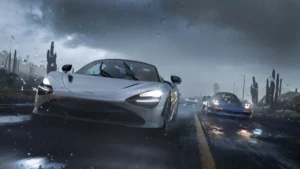
The world includes living deserts, dense jungle, historic colonial-style cities, hidden Mayan-inspired ruins, pristine coastline, deep canyons, and a snow-capped volcano that stands as the highest point ever featured in a Horizon map. That volcano is not just scenery — its elevation changes weather and driving conditions in real time, meaning a lap that starts in tropical heat can end in falling snow at altitude. Dynamic weather runs throughout the map more broadly, including tropical storms that can develop and pass through in real time, altering visibility and road grip while you drive.
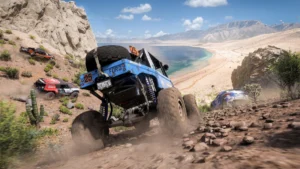
The scale of the map, combined with the biome variety, gives Forza Horizon 5 a level of environmental contrast that previous Horizon entries in single-climate settings like Britain or Australia couldn’t match. Within a single free-roam session, a player can go from beach driving to jungle trails to a colonial-era town square to sand dunes without ever loading a new area. That seamlessness is central to what makes the map feel less like a racing circuit collection and more like an actual place worth exploring.
The Horizon Festival: Story and Progression
The narrative and structural backbone of the game is the Horizon Festival, a fictional celebration of car culture, music, and motorsport that the series has used as its framing device since the first Forza Horizon. In Forza Horizon 5, the Festival sets up shop across Mexico in multiple regional outposts, each themed around the biome it sits in — a jungle outpost, a desert outpost, a coastal outpost, and so on.
Progression revolves around Accolades and Festival Playlist objectives rather than a rigid campaign. Players earn Festival Playlist points and Wheelspins (a slot-machine-style reward mechanic) by completing races, stunts, and challenges scattered across the map, which in turn unlock new events, cars, and cosmetic items. There is a loose story throughline tied to establishing new festival sites and dealing with in-fiction rivals and influencers, but it is deliberately lightweight — the narrative exists to justify unlocking more of the map and more content, not to deliver a scripted campaign in the traditional sense.
This open structure is a defining trait of the Horizon series as a whole: players choose their own path through races, PR Stunts, Speed Traps, Danger Signs, Bucket List challenges, and Horizon Adventure off-road events, rather than being funneled through them in sequence. That flexibility is part of why the game supports such long-term engagement — there’s always another activity type to chase, and the seasonal content structure (covered below) keeps refreshing what’s available.
Each regional Festival site also unlocks its own set of races and activities themed to that biome, so progress through the game doubles as a tour of the map’s biggest environmental set pieces. Reaching the volcano outpost, for instance, opens races that climb from jungle switchbacks into snow-line altitude, while coastal outposts lean into beach and cliffside routes. Because the Festival expands outward from an initial hub rather than gating players behind a strictly linear map, exploration and story progression reinforce each other instead of competing for the player’s attention.
Car Roster and Collection
Car collection is the other pillar of the Forza Horizon 5 experience. At launch, the game shipped with more than 500 licensed vehicles, the largest day-one roster the series had offered up to that point. That number has grown substantially since. As of the game’s 2026 content state, the official database tracked by Forza’s own car list resources shows the roster has expanded to roughly 900 vehicles, factoring in the base game, the Car Pass season of vehicle drops, the two expansions, standalone Car Packs, and monthly Festival Playlist additions.
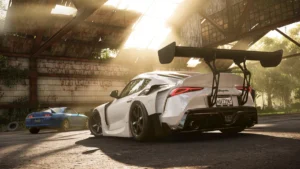
The roster spans everything from budget hatchbacks and classic muscle cars to hypercars, rally-prepped off-roaders, vintage trucks, and officially licensed manufacturer specials. Vehicles are organized by class and Performance Index (PI), a rating system that lets players build cars for specific competitive brackets rather than always driving the fastest thing available. This matters for online racing in particular, where PI classes keep races competitive between players running different vehicles.
Cars are acquired through a mix of methods: purchasing them directly with in-game credits earned from racing, winning them through Wheelspins and Super Wheelspins, unlocking them as story or seasonal rewards, or collecting them as part of the Car Pass and expansion content. Rare and Hoonigan-affiliated vehicles, along with manufacturer-exclusive cars, are typically gated behind specific challenges or limited-time seasonal events, giving completionist players long-term goals well beyond finishing the main Festival Playlist.
The Autoshow, the game’s in-world car dealership, organizes the roster by manufacturer and vehicle type, making it straightforward to browse everything from hot hatches and off-road trucks to hypercars and vintage rally icons in one place. Because the game continues to receive monthly content through the Festival Playlist, the exact composition of the “current” roster shifts over time — cars can rotate into featured Auction House listings or limited seasonal Wheelspin pools, which keeps the collecting loop active even for players who already own most of the base roster.
Customization: Tuning, Upgrades, and Liveries
Beyond simply owning cars, Forza Horizon 5 gives players deep control over how those cars perform and look. The Upgrades & Tuning menu is organized into distinct categories — engine, platform and handling, drivetrain, tires and rims, aero and appearance, and conversion — letting players rebuild a car’s performance profile from the ground up. Conversion upgrades, which can swap engines or drivetrains entirely, are widely considered the most consequential changes available, since they can shift a car’s Performance Index class and fundamentally alter how it drives.
Players who don’t want to tune manually can rely on Auto Upgrade, which builds a setup automatically for a target PI class, or download tunes shared by other players through the game’s online tune-sharing system. This makes advanced setups accessible to players who want performance gains without learning suspension geometry and gear ratios from scratch.
On the visual side, the livery editor lets players design custom paint jobs by layering vinyl shapes, logos, and masks directly onto a 3D model of the car. Finished liveries can be uploaded and shared with the wider community, and in turn, players can browse and download liveries created by others — everything from motorsport-accurate racing liveries to elaborate character art. Combined with the Forzavista mode, which lets players walk around and inspect any car in photorealistic detail, the customization suite turns car ownership into an extension of the collection hobby, not just a means to go faster.
Driving Physics and Accessibility Options
Forza Horizon has always positioned itself between full arcade racing and hardcore simulation, and Forza Horizon 5 continues that balancing act deliberately. Compared to Forza Motorsport’s simulation-first handling model, Horizon games favor accessibility and spectacle — but Playground Games reworked suspension and braking physics for this entry specifically to make handling feel more grounded and consistent than in previous Horizon titles, without sacrificing the forgiving, high-speed fun the series is known for.
A key piece of the AI experience is the Drivatar system, which models opponent racers based on the driving behavior of real players (including, at times, the player’s own friends list) rather than static difficulty curves. Drivatars aim to replicate individual habits — how aggressively someone brakes into corners, how they choose racing lines — while the game subtly balances their underlying performance so races stay competitive regardless of which car class is in play.
Accessibility is one of the more genuinely comprehensive areas of the game’s design. Forza Horizon 5 shipped with an accessibility menu reachable at the very start of the game, letting players adjust difficulty and gameplay assists, language, and subtitles before ever touching the open world. Specific features include:
- Individual colorblind filters for Deuteranopia (green), Protanopia (red), and Tritanopia (blue), applied separately to the game world and to UI/map icons
- A High Contrast mode to improve text and interface readability against the game’s varied, colorful backgrounds
- Game Speed Modification, which lets players run the game at a reduced rate
- Text-to-speech and speech-to-text support for voice chat
- Customizable subtitles, along with American Sign Language (ASL) and British Sign Language (BSL) interpretation for cinematic sequences
- The option to disable moving backgrounds for players sensitive to motion
That combination of physics tuning and accessibility depth is part of why the game is frequently recommended as an entry point for players who are new to racing games altogether, not just returning Forza fans.
On top of the accessibility settings, the game offers a broad range of standard driving assists that any player can adjust regardless of accessibility needs — braking assistance, steering assistance, damage settings, and traction and stability control can all be tuned independently, letting a single save file support anything from a fully assisted, controller-friendly setup to a stripped-down manual configuration for players running a wheel and pedal set. That range means the same core game can serve a player who has never played a racing title before and a player who wants close to a full simulation feel, without either one needing a different game.
Online Features: Horizon Life, Forzathon, and Seasonal Events
Forza Horizon 5’s online layer is built around Horizon Life, the shared online world where dozens of other real players drive around the same map in real time. Horizon Life unlocks after completing a handful of early races, and from there it opens up the game’s full suite of multiplayer activities, including Convoy (a persistent squad feature for grouping up with friends or other players for co-op free roam), Horizon Open for competitive matchmaking across disciplines like Road, Street, Dirt, Cross Country, and Drifting, and Forza Link, the leaderboard and social-challenge layer that ties activity across the community together.
Layered on top of free roam and competitive matchmaking is Forzathon, the game’s system of time-limited challenges. Forzathon Daily and Weekly challenges reward Forza Points for completing specific tasks — often themed around owning or driving particular cars — and completing a full Weekly Forzathon chapter set awards a meaningful chunk of Series points on top of the points reward itself.
All of this content is organized through the Festival Playlist, a rotating monthly structure Playground Games has maintained continuously since launch. Each numbered “Series” runs for roughly a month and is broken into four one-week seasons — typically themed around the actual seasons — each bringing its own limited-time events, Forzathon objectives, and rotating rewards. This is the mechanism that has kept Forza Horizon 5 feeling live years after release: Series 49, for example, was themed as a “Horizon 10 Year Anniversary” celebration running through mid-to-late 2025, and new Series content has continued on a steady monthly cadence since. The rotating structure means there is functionally always a fresh set of goals to chase, even for players who have already unlocked most of the base car roster.
EventLab: Build Your Own Forza
One of Forza Horizon 5’s most significant additions over prior entries is EventLab, a creation toolset that replaced the earlier Horizon “Blueprint” editor with something far more open-ended. EventLab lets players place start points, checkpoints, and finish lines anywhere on the map, configure rules like Performance Index limits, vehicle restrictions, drift-specific scoring, or timer-based challenges, and scatter props, ramps, and obstacles to build entirely custom events and mini-games.
The toolset received a major overhaul with EventLab 2.0, which added a multi-selection mode for grabbing, rotating, duplicating, and moving groups of props at once, along with the ability to save and reuse prop groupings across projects. EventLab 2.0 also gave creators direct control over time-of-day and weather conditions while building, so a track designed for a sunset drift session or a rain-soaked rally stage renders exactly as intended for players who load it later. A Prefabs system rounds this out, letting creators combine multiple individual props into single reusable “mega props” that the wider community can drop into their own builds.
Finished EventLab creations can be published and shared, and the tool has become a genuine creative hub within the game — home to everything from faithful recreations of real-world circuits to elaborate stunt courses and physics-breaking mini-games that have little to do with racing at all. For a game already built around freedom of movement, EventLab extends that freedom to the act of level design itself.
Expansions and DLC: Hot Wheels and Rally Adventure
Forza Horizon 5 received two paid story expansions, both of which meaningfully expanded the map rather than simply adding cosmetic content.
Hot Wheels, the first expansion, layered an entirely new elevated area onto the map built from the iconic orange Hot Wheels track pieces — loops, jumps, bends, and gravity-defying stretches of road totaling roughly 131 miles (212 km). The Hot Wheels Park is broken into distinct biomes with names like the Ice Cauldron, Forest Falls, and Giant’s Canyon, all connected through a central area called the Horizon Nexus. The expansion also added 10 unlockable vehicles themed around the Hot Wheels brand.
Rally Adventure, the second expansion, took a different approach, introducing a new mainland region called Sierra Nueva. Rather than the stylized, physics-defying design of Hot Wheels Park, Sierra Nueva focuses on unpredictable, biome-diverse rally terrain across roughly 6.25 square miles (16.2 square kilometers) of new map space and about 38 miles (61 km) of drivable roads. Locations include an abandoned quarry and a forest of palm trees that is described as entirely smashable, giving rally-focused driving a genuine sense of environmental consequence. Rally Adventure also added 10 more collectible vehicles.
Both expansions are sold individually or bundled together as the Expansions Bundle (also called the Expansions Pass), and both are included automatically with the Premium Edition and Premium Add-Ons Bundle of the base game. Standalone pricing has placed Rally Adventure at $19.99, with the combined Expansions Pass covering both expansions for $35. Beyond the two paid expansions, Forza Horizon 5’s content pipeline also includes the Car Pass (a season of drip-fed vehicle unlocks) and standalone Car Packs, both of which contribute to the game’s now-massive combined vehicle count.
Unlike some open-world expansions that simply bolt on a side area, both Hot Wheels and Rally Adventure are structured as self-contained mini-campaigns with their own progression tracks, unique vehicles, and unlockable rewards, meaning they add meaningful playtime beyond just new scenery. Players typically need to reach a certain point in the base game’s Festival Playlist before an expansion’s content becomes accessible, so newcomers are generally better served spending time in the core Mexico map first before jumping into Hot Wheels Park or Sierra Nueva.
Platforms and Game Pass
Forza Horizon 5 launched on November 9, 2021, for Xbox One, Xbox Series X|S, and Windows PC, with Premium Edition and Premium Add-On Bundle owners getting early access from November 5, 2021. Notably, the game reached PlayStation 5 later than its original console siblings — it launched on PS5 on April 29, 2025, with Premium Edition buyers able to start on April 25, 2025. The PS5 release includes both a Performance mode (targeting 60 frames per second) and a Quality mode (targeting 30 frames per second), giving players a choice between smoother frame rates and higher visual fidelity.
On PC, the game is available through both the Microsoft Store and Steam, and it supports cross-play and cross-save between Xbox and PC (subject to platform-specific matchmaking pools). It has also been part of Xbox Game Pass and PC Game Pass since launch, meaning subscribers to Xbox Game Pass Ultimate or PC Game Pass can play the Standard Edition without an additional purchase, and the game is playable via Xbox Cloud Gaming for streaming on unsupported hardware.
For players running the game natively on PC, Forza Horizon 5 scales across a wide hardware range with three general performance tiers:
- Minimum (roughly 720p): Ryzen 3 1200 or Intel Core i5 4460 CPU, Radeon RX 470 or Nvidia GTX 970 GPU (4GB VRAM), 8GB RAM, 110GB storage
- Recommended (roughly 1080p): Ryzen 5 1500X or Intel Core i5 8400 CPU, Radeon RX 590 or Nvidia GTX 1070 GPU (8GB VRAM), 16GB RAM, 110GB storage
- Ideal (1440p-4K): Ryzen 7 3800XT or Intel Core i7-10700K CPU, Radeon RX 6800 XT (16GB) or Nvidia RTX 3080 (10GB) GPU, 16GB RAM, 110GB SSD storage
That range is intentionally broad — the minimum spec includes hardware that’s several years old, while the ideal tier is built around then-current high-end components capable of pushing ray tracing and 4K rendering. The PC version also supports ultrawide monitors, uncapped frame rates for players with high-refresh displays, and a range of graphics presets that can be tuned individually rather than only through global quality tiers, giving players on mid-range hardware room to balance visual fidelity against frame rate rather than accepting a single fixed preset.
Critical Reception
Forza Horizon 5 was met with widespread critical acclaim at launch and has held up as one of the best-reviewed entries in the franchise. The game holds a Metacritic score of 91, earning the platform’s “Must-Play” badge — a tier generally reserved for genuine Game of the Year contenders. Multiple major outlets, including IGN, TheGamer, and Windows Central, awarded the game a perfect 10/10, and critical consensus placed no major review below an 8 out of 10.
Reviewers consistently praised the game’s visual fidelity, the sheer variety and quality of the Mexico setting, the depth of the car roster, and the refinement of systems the series had been building since its first entry. The most common critical note was that Forza Horizon 5 didn’t introduce as many structural innovations as Forza Horizon 4 had over its own predecessor — but critics broadly agreed that the game took the established Horizon formula and executed it about as well as it could be executed, delivering what several reviews called the best entry in the series to date.
Tips for New Players
Getting the most out of Forza Horizon 5 early on comes down to understanding a few systems before diving deep into car collecting:
- Unlock Horizon Life early. Completing the first handful of races unlocks the online hub, giving access to Convoy, Horizon Open, and the Festival Playlist — all of which feed rewards back into single-player progression, so there’s little reason to stay offline for long.
- Don’t ignore Auto Upgrade. New players intimidated by the full tuning menu can lean on Auto Upgrade to build a competent setup for a target PI class, then gradually learn manual tuning once they understand what each category does.
- Prioritize Accolades and Wheelspins over grinding a single event type. Because progression is nonlinear, spreading activity across races, PR Stunts, and Bucket List challenges accelerates unlocks faster than repeating one race type.
- Check the Festival Playlist every Series. Since content rotates monthly with weekly seasonal changes, checking in regularly ensures players don’t miss limited-time cars or challenges tied to a specific season.
- Use the accessibility menu on first launch. Even players who don’t need assistive features may find the colorblind filters, high-contrast UI, or game speed adjustments useful for simply seeing the world more clearly at high speed.
- Treat the map itself as content. With biomes ranging from jungle to volcano to desert, simply free-roaming and taking in the environment — including using Forzavista to inspect cars up close — is a legitimate way to spend time in the game, not a distraction from “real” progress.
Who Is Forza Horizon 5 For?
Forza Horizon 5 is built to appeal broadly rather than narrowly. Players who want pure simulation racing with strict physics and no hand-holding are generally better served by Forza Motorsport or dedicated sim titles; Horizon deliberately favors accessibility and spectacle over precision. But for nearly everyone else, the game has an entry point.
Car enthusiasts will find a roster approaching 900 vehicles and a tuning system deep enough to reward real mechanical understanding. Casual players benefit from forgiving handling, a nonlinear structure that never forces a difficult section before progress can continue, and an accessibility suite that lowers barriers around vision, motion sensitivity, and communication. Creative players have EventLab and the livery editor as genuine tools for self-expression rather than side novelties. Social players have Horizon Life, Convoy, and Horizon Open for shared driving and competition. And with the game available on Xbox Game Pass and PC Game Pass, the barrier to simply trying it is lower than most AAA releases of its scale.
FAQ
Is Forza Horizon 5 available on PlayStation 5? Yes. Forza Horizon 5 launched on PS5 on April 29, 2025 (April 25, 2025 for Premium Edition owners), following its original 2021 launch on Xbox and PC. The PS5 version includes both a 60fps Performance mode and a 30fps Quality mode.
How many cars are in Forza Horizon 5? The game launched in November 2021 with more than 500 vehicles — the largest day-one roster in the series at that point. Through the Car Pass, standalone Car Packs, monthly Festival Playlist additions, and the two paid expansions, the roster has grown to roughly 900 vehicles as of the game’s current content state.
Is Forza Horizon 5 included with Xbox Game Pass? Yes. Forza Horizon 5’s Standard Edition is included with Xbox Game Pass and PC Game Pass, including Xbox Game Pass Ultimate, and it’s also playable through Xbox Cloud Gaming. Premium content, including the two expansions, is not automatically included and can be purchased separately or bundled through higher game editions.
What is EventLab in Forza Horizon 5? EventLab is the game’s in-built creation toolset, replacing the earlier Horizon Blueprint editor. It lets players design custom races, stunts, and mini-games by placing checkpoints, props, and rule sets anywhere on the map, then publish and share their creations with the community. EventLab 2.0 added multi-object editing, adjustable time-of-day and weather for creations, and a Prefabs system for combining props into reusable assets.
What are the Hot Wheels and Rally Adventure expansions? Hot Wheels is a paid expansion adding an elevated track-based area built from Hot Wheels-branded loops, jumps, and ramps across several themed biomes, plus 10 new cars. Rally Adventure adds a new mainland region called Sierra Nueva with rugged, biome-diverse rally terrain and 10 more collectible cars. Both are available standalone, bundled as the Expansions Pass, or included with the Premium Edition.
Does Forza Horizon 5 support accessibility features like colorblind modes? Yes. The game includes an accessibility menu accessible from the very start, with individual colorblind filters for Deuteranopia, Protanopia, and Tritanopia, a high-contrast UI mode, adjustable game speed, customizable subtitles, ASL and BSL support for cinematics, and text-to-speech/speech-to-text options for voice chat.
Conclusion
Forza Horizon 5 earned its reputation the direct way: by combining an unusually varied and technically impressive open world with systems — car collection, tuning, livery design, EventLab creation, and a constantly rotating Festival Playlist — that give players reasons to keep returning years after launch. Its move to Mexico gave the series its most visually diverse setting yet, its expansions extended that world in genuinely different directions with Hot Wheels and Rally Adventure, and its arrival on PlayStation 5 in 2025 brought the game to an entirely new audience years into its lifecycle. Combined with its presence on Xbox Game Pass and PC Game Pass, and a critical reception that placed it among the best-reviewed racing games of its generation, Forza Horizon 5 remains one of the most accessible, content-rich entry points into open-world racing available today — whether you’re chasing a full car collection, building custom EventLab tracks, or simply driving through a volcano at sunset.
External Authority Sources
- Forza Horizon 5 – Official Site (Forza.net)
- Forza Horizon 5 – Metacritic Critic Reviews
- Gaming for Everyone: The Accessibility Features of Forza Horizon 5 – Xbox Wire
- Forza Horizon 5 Map Creators: Build Your Next Masterpiece with EventLab 2.0 – Xbox Wire