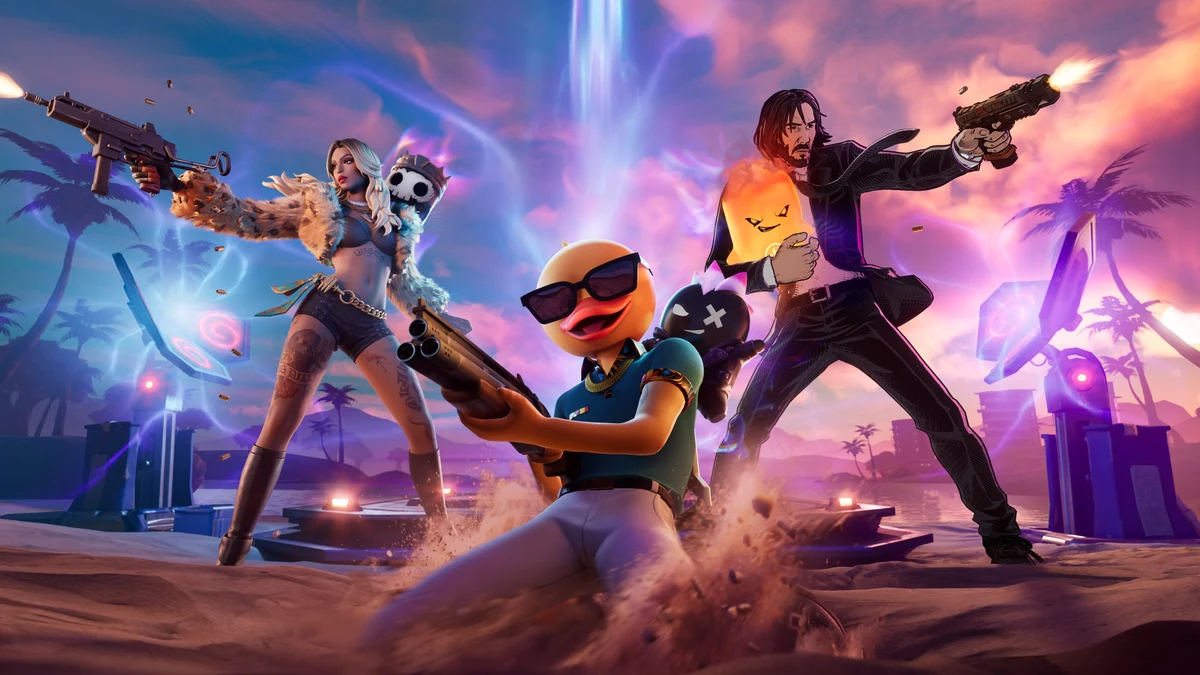
Table of Contents
- What Is Fortnite Today
- Who Fortnite Is Best For
- Platforms and Crossplay
- Current Chapter and Season Explained: Chapter 7, Season 3 “Runners”
- Game Modes Explained
- Battle Pass and V-Bucks Explained
- Fortnite for Beginners
- Best Landing Spots and Early-Game Strategy
- Skins, Collabs, and Fortnite’s Cultural Reach
- Competitive Fortnite and FNCS
- Hardware and Setup Tips for Better Performance
- Frequently Asked Questions
- Conclusion
Fortnite stopped being “just a battle royale game” years ago, and in 2026 the gap between what it was and what it is now is wider than ever. Epic Games’ platform currently pulls somewhere around 110-120 million monthly active players across nine-plus platforms, hosts a $10 million-plus competitive circuit, runs a creator economy that has paid out over a billion dollars to independent developers, and just went through one of its biggest map resets in years with Chapter 7. If you last checked in during the OG nostalgia seasons or haven’t touched it since Zero Build launched, a lot has changed — some modes are gone, pricing has shifted, and the map you remember doesn’t exist anymore. This guide covers exactly where Fortnite stands right now, in August 2026: the current season, every mode that’s actually still live, what things cost, how crossplay works, and how to get good fast whether you’re brand new or coming back after a long break.
What Is Fortnite Today
Calling Fortnite a “battle royale game” in 2026 undersells it the same way calling YouTube “a place for cat videos” undersells YouTube. Battle Royale is still the flagship mode and the reason most people open the app, but Epic has spent the last several years turning Fortnite into what it now openly describes as an entertainment platform — a single client that houses a 100-player last-man-standing shooter, a social hangout game, a rhythm game, and an entire third-party creation ecosystem, all sharing one account, one friends list, and one wallet of V-Bucks.
The clearest evidence of that shift is Unreal Editor for Fortnite (UEFN), Epic’s professional-grade creation toolkit built on real Unreal Engine tech. Player-made islands built in UEFN now account for roughly 47% of all time spent in Fortnite, according to Epic’s own reporting, up from about 38% a year earlier — meaning nearly half of everything players do in Fortnite happens inside experiences Epic itself didn’t design. Creators have collectively earned more than $1 billion through the Creator Economy program, turning Fortnite into something closer to a distribution platform for independent game developers than a single game with one mode.
Add in a rhythm-game arm (Fortnite Festival), a LEGO-branded survival-and-social sandbox (LEGO Fortnite), a decade-plus back catalog of licensed crossovers from Marvel to Star Wars to anime, and a genuine esports circuit with an eight-figure prize pool, and “Fortnite” in 2026 functions more like a portfolio of games under one roof than a single title. That’s why Epic itself now talks about “the Fortnite ecosystem” rather than just the game.
That doesn’t mean every experiment has survived. Epic went through a real belt-tightening moment in March 2026, laying off over a thousand staff and pulling the plug on modes that never found a sustainable audience, including Ballistic and Rocket Racing. The lesson for anyone evaluating Fortnite today is that the platform is still expanding in the areas that work — creator content, LEGO Fortnite, Festival, competitive Battle Royale — while quietly retiring the parts that didn’t. That’s a healthier signal than it might first sound: it means Epic is treating Fortnite less like a single product to protect at all costs and more like a live portfolio it’s willing to prune.
Who Fortnite Is Best For
Fortnite isn’t a fit for everyone, and it’s worth being honest about that before diving into strategy and settings.
Fortnite is a strong fit if you:
- Want a genuinely free, no-paywall-to-compete shooter with a skill ceiling that rewards hundreds of hours of practice.
- Like variety — you can grind ranked Battle Royale one night and chill in LEGO Fortnite building a base the next, without leaving the app.
- Play with a squad across different consoles or PC, since full crossplay means platform doesn’t matter.
- Enjoy live-service content — new map, new mechanics, and a new Battle Pass roughly every 10-12 weeks keeps it from going stale.
- Are interested in game development — UEFN gives hobbyists and small studios a real path to publishing and monetizing playable content to a massive audience.
You might want to skip it, or expect a rough first few hours, if you:
- Dislike battle royale’s core loop of long stretches of looting punctuated by sudden, often unforgiving fights.
- Aren’t willing to learn building or the mode-specific mechanics — Fortnite’s building system in particular has a steep, well-documented learning curve.
- Get frustrated by frequent balance changes; the meta shifts every season, sometimes dramatically.
- Are looking for a strictly single-player or narrative-driven experience — Fortnite is fundamentally social and live-service by design.
Platforms and Crossplay
Fortnite runs on PC (via the Epic Games Store), PlayStation 4 and 5, Xbox One and Xbox Series X|S, Nintendo Switch and Switch 2, iOS, Android, and cloud streaming services including GeForce NOW, Xbox Cloud Gaming, and Amazon Luna. Notably, Fortnite returned to Apple’s App Store worldwide, including the U.S., in May 2026, closing out years of legal disputes between Epic and Apple and making native iPhone/iPad installs possible again without sideloading workarounds.
How Crossplay Actually Works
Crossplay is enabled by default across every platform. PC, console, and mobile players all draw from the same matchmaking pool in Battle Royale, Zero Build, and every other core mode, so a friend on Xbox, a friend on Switch, and you on PC can queue into the exact same lobby without any manual setup. Console players do have the option to disable crossplay in their platform’s system settings if they’d rather only match against players on the same hardware, but it’s opt-out, not opt-in.
Cross-progression is handled the same way. Your Epic Games account — not your console or platform — owns your skins, Battle Pass progress, V-Bucks balance, and stats, so switching from console to PC mid-season loses you nothing. The one asterisk is Save the World, Fortnite’s original PvE mode, which still has some platform-specific quirks. For a deeper breakdown of exactly how input-based matchmaking and skill-based matchmaking interact with crossplay, our Fortnite crossplay guide covers the setup process and common connection issues platform by platform.
| Platform | Crossplay | Cross-Progression | Notes |
|---|---|---|---|
| PC (Epic Games Store) | Yes, default on | Yes | Highest frame rate ceiling, keyboard/mouse input |
| PlayStation 4/5 | Yes, opt-out | Yes | Console default; controller input pool |
| Xbox One/Series X|S | Yes, opt-out | Yes | Console default; controller input pool |
| Nintendo Switch/Switch 2 | Yes, default on | Yes | Lower resolution/performance ceiling |
| iOS | Yes, default on | Yes | Returned to App Store worldwide, May 2026 |
| Android | Yes, default on | Yes | Available via Google Play and Epic Games app |
| Cloud (GeForce NOW, Xbox Cloud) | Yes, default on | Yes | Streams from PC/console builds |
Current Chapter and Season Explained: Chapter 7, Season 3 “Runners”
As of August 2026, Fortnite Battle Royale is in Chapter 7, Season 3: Runners, which launched June 6, 2026, and is scheduled to run until roughly August 19-20, 2026, when the v42.00 update ushers in Chapter 7 Season 4.
The Map: Shattered Coast
After the Zero Point fractured the Chapter 7 island, this season reassembled the world into a mid-chapter map called the Shattered Coast — a mix of altered, familiar points of interest and new crystalline, unstable-energy zones. Notable changes include Dark Dominion being replaced by a new tropical location with the Zero Point itself exposed at its center, and Duck Mansion, a new POI tied to the season’s duck-themed Battle Pass content.
The Sprites Mechanic
The headline new system this season is Sprites — small collectible entities that, unlike their earlier one-off appearance in Chapter 6, can now be permanently collected and carried forward into future matches. Players secure Sprites at extraction sites scattered around the map and have to survive a timer to successfully exfil with them, adding a genuine risk-reward extraction-shooter layer on top of standard battle royale looting.
New Movement and Items
Runners leans hard into speed. Power Boots and a new mobility item called Seven Sliders — which lets players slide faster than they can sprint — were added specifically to support a faster, more aggressive pace of play this season, a deliberate shift from the slower, more methodical seasons that preceded it.
What’s Coming Next
Season 4, codenamed Override, is set to launch alongside the v42.00 patch around August 19-20, 2026. Epic hasn’t officially detailed the theme yet, but reliable dataminers have pointed to a “Gaming Legends” direction with rumored crossovers involving classic gaming franchises like Mega Man, Sonic the Hedgehog, and Tetris. Treat those specifics as unconfirmed until Epic’s official reveal, but expect the transition to bring another full map shift, as Chapter 7 has done with each season so far.
Image suggestion: A wide screenshot of the Shattered Coast map with POIs labeled — alt text: “Fortnite Chapter 7 Season 3 Runners map showing the Shattered Coast and Duck Mansion POI.”
Game Modes Explained
Fortnite’s mode lineup shrank in 2026 as Epic trimmed underperforming experiences following a round of layoffs and cost-cutting announced in March 2026. Here’s the accurate, current state of every mode as of this writing.
Battle Royale
The core 100-player last-man-standing mode, with full building mechanics available. This is still Fortnite’s flagship and the mode the Battle Pass, map, and seasonal storylines are built around.
Zero Build
A no-building variant of the same battle royale loop, designed for players who want the shooting and rotation strategy without the building skill gate. Zero Build consistently draws 45-55% of the total Fortnite player base, essentially splitting the community evenly with traditional build mode. A major May 2026 update (v40.40) reworked the mode significantly: it added “Pocket Items” (a free random utility item every match with unlimited uses), removed fatal fall damage, and brought back permanent glider redeploy — all changes aimed at making Zero Build faster and more gunplay-focused.
LEGO Fortnite
Unlike Rocket Racing and Ballistic, LEGO Fortnite was explicitly not part of the 2026 mode cuts and continues receiving regular content. It splits into two experiences: Odyssey, a survival-crafting mode, and Brick Life, a social roleplay mode that launched in December 2024 where players hold jobs, decorate homes, and hang out in a LEGO-styled city. Recent updates have added new jobs (like the City Gardener role), weather systems, and expanded housing decoration limits.
Fortnite Festival
Epic’s rhythm-game mode, built around real licensed music tracks, still runs its Main Stage and Jam Stage components normally. Festival Battle Stage, a separate competitive PvP variant of the rhythm mode, was discontinued in April 2026 as part of the broader mode cuts — but it’s important to note the core Festival experience (playing along to songs solo or with friends) was not affected and remains fully active.
Rocket Racing
Epic’s Mario Kart-style racing mode is in its final stretch. It’s technically still playable as of August 2026, but Epic confirmed it will be fully removed from Fortnite in October 2026, and UEFN’s dedicated track-creation template for the mode has already been discontinued ahead of the full shutdown.
Ballistic
Fortnite’s tactical, Counter-Strike-style first-person mode was terminated on April 16, 2026, and is no longer available.
UEFN Custom Islands
Beyond Epic’s own modes, the Discover tab is home to tens of thousands of player- and studio-built islands created in Unreal Editor for Fortnite — everything from horror maps and tycoon games to full narrative experiences. These islands now represent close to half of all Fortnite playtime and operate on a real monetization system, including a Creator Economy 2.0 engagement payout pool and, through the remainder of 2026, creators keeping the full revenue from in-island V-Bucks sales before the split shifts to a shared model.
| Mode | Type | Status (Aug 2026) | Best For |
|---|---|---|---|
| Battle Royale | 100-player shooter, building enabled | Live, core mode | Players who enjoy building and full skill expression |
| Zero Build | 100-player shooter, no building | Live, actively updated | Players who want pure gunplay and rotation strategy |
| LEGO Fortnite (Odyssey/Brick Life) | Survival crafting / social roleplay | Live, permanent, regularly updated | Casual, social, or younger players |
| Fortnite Festival (Main/Jam Stage) | Rhythm game | Live | Music fans, casual party play |
| Festival Battle Stage | Competitive rhythm PvP | Discontinued April 2026 | N/A |
| Rocket Racing | Kart racing | Live, closing October 2026 | Players who enjoy arcade racing (limited window left) |
| Ballistic | Tactical FPS | Terminated April 2026 | N/A |
| UEFN Custom Islands | Player/studio-created content | Live, expanding | Anyone wanting variety beyond Epic’s own modes |
Battle Pass and V-Bucks Explained
Fortnite’s core economy still runs on V-Bucks, the premium in-game currency used to buy the seasonal Battle Pass, cosmetic items, and Bundle content. As of March 19, 2026, the price of the Battle Royale Battle Pass dropped from 1,000 V-Bucks to 800 V-Bucks, a change Epic made alongside broader repricing across the store. Completing the pass still returns a mix of V-Bucks through Bonus Rewards, effectively letting active players offset a chunk of next season’s cost through play rather than repurchasing every time — check the official Fortnite Battle Pass page for the current season’s exact reward track.
Fortnite Crew Subscription
For players who want ongoing access without buying passes individually, Fortnite Crew remains available at $11.99/£9.99 per month. It bundles the Battle Royale Battle Pass, the OG Pass, the LEGO Pass, and the Music Pass, plus monthly V-Bucks and an exclusive Crew Pack of cosmetics. One change worth flagging: starting June 6, 2026, the monthly V-Bucks included with new or renewing Crew subscriptions dropped from 1,000 to 800, matching the reduced Battle Pass price. Existing subscriptions that renewed before that date kept the old 1,000 V-Bucks rate until their next renewal cycle.
Buying V-Bucks Directly
V-Bucks can still be purchased directly through the Epic Games Store, in-game item shop, or on console storefronts in fixed bundles. Epic also raised V-Bucks prices in some regions in 2026, citing rising platform and support costs, so it’s worth checking current regional pricing before assuming older price-per-bundle figures still apply.
Fortnite for Beginners
If you’re starting from zero in 2026, the good news is that Fortnite has never done a better job of onboarding new players — but the game itself is deeper than it looks. The core loop is simple: drop onto the island, gather weapons and materials, survive the shrinking storm circle, and try to be the last player or squad standing. The complexity comes from everything layered on top — building mechanics, editing structures mid-fight, item rarity tiers, and a map that changes meaningfully every season.
The single biggest decision for a new player is choosing between standard Battle Royale (building enabled) and Zero Build. Building has a real learning curve — walls, ramps, and floors placed instantly can turn a losing gunfight into a win, but only once you’ve built enough muscle memory to do it under pressure. Zero Build strips that away entirely and lets you focus purely on movement, aim, and positioning, which is why it’s become the default recommendation for anyone who wants to get competent fast without spending weeks in Creative practicing edit courses.
Beyond mode choice, new players benefit enormously from getting sensitivity, keybinds, and HUD settings right early rather than fighting default settings for dozens of matches. Our full Fortnite beginner’s guide walks through mode selection, essential keybinds, material/loot priority, and the first habits worth building in your opening 10-20 games, so you’re not relearning bad habits later.
Best Landing Spots and Early-Game Strategy
Where you land dictates almost everything about your early game — loot quality, fight frequency, and rotation options into the mid-game. On the current Shattered Coast map, named POIs and their surrounding satellite locations offer meaningfully different risk profiles: named locations tend to have denser loot and more player traffic (higher risk, faster gearing up), while edge-of-map or satellite POIs are quieter but leave you with a longer rotation into the closing circles.
A few strategic principles hold up regardless of which map iteration you’re playing:
- Match your landing spot to your goal. If you’re grinding for eliminations or trying to build mechanical skill, land somewhere contested. If you’re pushing for placement (relevant for both casual wins and ranked points), land on the edge and rotate smart.
- Track the storm’s first circle before you land, not after — knowing roughly which side of the map the circle favors lets you land with a rotation plan already in mind instead of improvising under pressure.
- Prioritize shield and mobility items over weapon upgrades in the opening two minutes; a full shield and any means of rotation beats a slightly better gun in a chaotic early game.
- Reassess POI value every season. Because Chapter 7’s map reshuffles regularly, a “safe” landing spot from Season 2 may now be a contested Sprite extraction site in Season 3.
For a POI-by-POI breakdown of the current season’s best drops, loot density, and rotation paths, our dedicated Fortnite best landing spots guide is updated alongside each map change.
Image suggestion: An aerial map screenshot with landing zone risk levels overlaid — alt text: “Fortnite landing spot risk map showing high-loot contested zones versus quiet edge POIs.”
Skins, Collabs, and Fortnite’s Cultural Reach
Cosmetics have always been Fortnite’s actual business model — the battle royale itself is free, and the entire economy runs on skins, emotes, and Battle Pass sales. What’s changed is the sheer scale of licensed content built around that system. As of early 2026, Fortnite has surpassed 400 collaboration skins across its history, spanning Marvel, DC, Star Wars, major anime franchises, and a growing roster of musical artists through past Icon Series and concert tie-ins.
2026 alone is on pace for more than 40 new collaborations, many tied to Epic’s ongoing partnership with the Epic Games Store, where purchasing select partner titles grants a free in-game Fortnite skin. Confirmed 2026 crossover content includes tie-ins with upcoming titles like Resident Evil Requiem and Crimson Desert, continuing a pattern where Fortnite functions as a marketing surface for games, movies, and music releases well beyond its own player base.
This is also where Fortnite Festival ties back into the platform’s broader cultural footprint — the mode grew directly out of Epic’s earlier in-game concert experiments, which turned Fortnite into a legitimate live-event venue years before other games attempted the same thing. Combined with the UEFN creator ecosystem giving independent developers a route to build inside a AAA-scale audience, Fortnite has become less a “game” in the traditional sense and more a recurring cultural touchpoint — something closer to a shared digital space that intersects gaming, music, film, and fashion on a rolling basis, each new season resetting the conversation.
What makes this system durable rather than gimmicky is the currency underneath it. Every collab, every Icon Series skin, every concert tie-in ultimately funnels back through the same Battle Pass and V-Bucks economy covered earlier, which means a partner brand gets access to an audience north of 100 million monthly players without needing to build or market its own game. That’s a genuinely unusual position for a video game to hold, and it’s a big part of why studios and franchises keep lining up for a season or two on Fortnite’s map rather than treating it as a one-off marketing stunt.
Competitive Fortnite and FNCS
Fortnite’s esports scene runs through the Fortnite Championship Series (FNCS), and the 2026 season carries a total prize fund exceeding $10 million across its full calendar of online qualifiers, regional Majors, and the season-capping Global Championship.
The competitive path in 2026 runs through multiple Majors held throughout the year, each narrowing the field toward the top event. FNCS Major 2’s online rounds began July 18, 2026, with finals held August 1-2 that qualified the top 25 duos directly into the Global Championship. Rather than a third full Major, Epic replaced that slot with a Last Chance Qualifier starting August 3, 2026, which determines the remaining ten duos needed to complete the field.
The 2026 Fortnite Global Championship, produced in partnership with BLAST, takes place September 26-27, 2026, in Antwerp, Belgium, carrying a standalone $2 million prize pool — consistent with the 2024 Global Championship. The format puts 50 duos through 12 games across two days, with standings determined by a combination of placement points and eliminations, the same scoring philosophy FNCS has used across recent seasons. Full rules, regional splits, and updated brackets are maintained on the official Fortnite competitive hub.
Competitive Fortnite plays meaningfully differently from casual matches — box fighting, edit courses, and endgame zone control dominate at the top level, and most competitive players spend significant time in Creative practicing mechanics outside of live matches. If competitive play is a genuine goal rather than a casual aspiration, dialing in consistent settings early matters more than almost anything else you can do to improve.
Hardware and Setup Tips for Better Performance
Fortnite is playable on almost anything, but there’s a real, measurable gap between “playable” and “competitive-ready,” and it’s mostly down to input consistency and display responsiveness rather than raw graphics horsepower.
Settings Matter More Than Specs, Up to a Point
Before spending money on hardware, get your in-game settings right — sensitivity, build/edit binds, and HUD layout affect performance more than most gear upgrades at a casual-to-intermediate skill level. Our Fortnite best settings and controller guide covers optimized configs for both controller and keyboard/mouse players, including the edit-hold vs. edit-reset debate and recommended dead zones for controller aim.
When a Mouse Upgrade Actually Helps
Once settings are dialed in, input hardware becomes the next real lever, particularly for keyboard-and-mouse players. Fortnite’s building and editing mechanics demand fast, precise, repeatable clicks and flicks — a mouse with an inconsistent sensor or laggy click response will cost you fights that have nothing to do with aim skill. If you’re still on a budget or all-purpose mouse, our gaming mouse buying guide breaks down sensor quality, weight, and grip style specifically for fast-paced shooters like Fortnite, rather than generic “gaming mouse” marketing claims.
Monitor Refresh Rate and Competitive Play
Display performance matters just as much, arguably more, in a game built around split-second building and editing. A 144Hz or 240Hz monitor with low input lag noticeably shortens the time between your input and what appears on screen compared to a standard 60Hz display, which is a real, quantifiable edge in close-range fights and box fights specifically. If you’re deciding between panel types or refresh rates for a Fortnite-focused setup, our gaming monitor buying guide explains the tradeoffs between refresh rate, resolution, and panel type in plain terms.
Quick Performance Checklist
- Cap or match your frame rate to your monitor’s refresh rate to avoid screen tearing without sacrificing responsiveness.
- Turn off unnecessary background overlays and recording software while playing ranked or competitive matches.
- On console, prioritize Performance Mode over Fidelity Mode if your setup supports it — frame rate matters more than resolution in build fights.
- Keep a stable wired connection where possible; Fortnite’s building system is unforgiving of packet loss and inconsistent ping.
Image suggestion: A side-by-side comparison graphic of a 60Hz vs. 144Hz build-fight sequence — alt text: “Comparison of Fortnite build fight responsiveness on 60Hz versus 144Hz monitor refresh rates.”
Frequently Asked Questions
Is Fortnite free to play? Yes. Battle Royale, Zero Build, LEGO Fortnite, Fortnite Festival, and UEFN custom islands are all free to download and play. Optional spending covers cosmetics, the Battle Pass, and the Fortnite Crew subscription — none of it affects competitive matchmaking or in-match power.
What platforms is Fortnite available on in 2026? PC, PlayStation 4/5, Xbox One and Series X|S, Nintendo Switch and Switch 2, iOS, Android, and cloud streaming services like GeForce NOW and Xbox Cloud Gaming. Fortnite returned to Apple’s App Store worldwide in May 2026 after a long legal dispute with Apple.
Does Fortnite have crossplay? Yes, crossplay is enabled by default across every platform, putting PC, console, and mobile players into the same matchmaking pool. Console players can disable it manually in system settings if they prefer same-platform-only lobbies.
What’s the difference between Battle Royale and Zero Build? Battle Royale includes Fortnite’s full building system — walls, ramps, floors placed in real time as a defensive and offensive tool. Zero Build removes building entirely and focuses purely on gunplay, movement, and positioning. Both run the same map, same loot, and roughly the same 100-player format.
How much does the Fortnite Battle Pass cost? As of March 2026, the Battle Royale Battle Pass costs 800 V-Bucks, down from its previous 1,000 V-Bucks price. Fortnite Crew subscribers get the current season’s Battle Pass included automatically as part of their $11.99/month subscription.
Is LEGO Fortnite a separate game I need to download? No. LEGO Fortnite is a mode inside the main Fortnite app, accessible from the same lobby as Battle Royale. It includes Odyssey (survival crafting) and Brick Life (social roleplay), and unlike some other modes, it wasn’t affected by Epic’s 2026 mode cuts.
What happened to Rocket Racing and Ballistic? Epic announced in March 2026 that it would shut down Rocket Racing, Ballistic, and Festival Battle Stage as part of broader cost-cutting. Ballistic and Festival Battle Stage were both terminated April 16, 2026. Rocket Racing is still playable as of August 2026 but is scheduled for full removal in October 2026.
How do I get started competing in FNCS? FNCS runs open online qualifiers before each Major, meaning any player who meets the account requirements can enter, with the field narrowing through in-game qualifier rounds toward regional Majors and eventually the Global Championship. Details on entry requirements and scheduling are published on Fortnite’s official competitive hub ahead of each Major.
Conclusion
Fortnite in 2026 rewards showing up with current information more than almost any other live-service game, because so much of it genuinely changes every few months — the map, the pricing, even which modes still exist. Right now that means Chapter 7 Season 3’s Shattered Coast and Sprite extraction loop, a leaner mode lineup after Rocket Racing and Ballistic’s wind-down, a cheaper Battle Pass, and a creator economy that’s quietly become nearly half of all Fortnite playtime. None of that changes the fundamentals that made it popular in the first place: it’s free, it’s cross-platform, and the skill ceiling is still high enough to chase for years.
If you’re picking it back up or starting fresh, don’t try to absorb everything at once. Start with our beginner’s guide to get your mode choice and settings sorted, then work through landing spot strategy once the fundamentals feel comfortable. Fortnite rewards consistency far more than any single hardware upgrade or settings tweak — but getting the basics right early will save you dozens of frustrating matches later.
External Authority Sources
- Fortnite Official News — Epic Games
- Fortnite Battle Pass — Official Page — Epic Games
- Fortnite Championship Series 2026 — Competitive Hub — Epic Games
- Fortnite Crew Subscription — Official Page — Epic Games
- Fortnite Is Back on the App Store Around the World — Epic Games Newsroom