
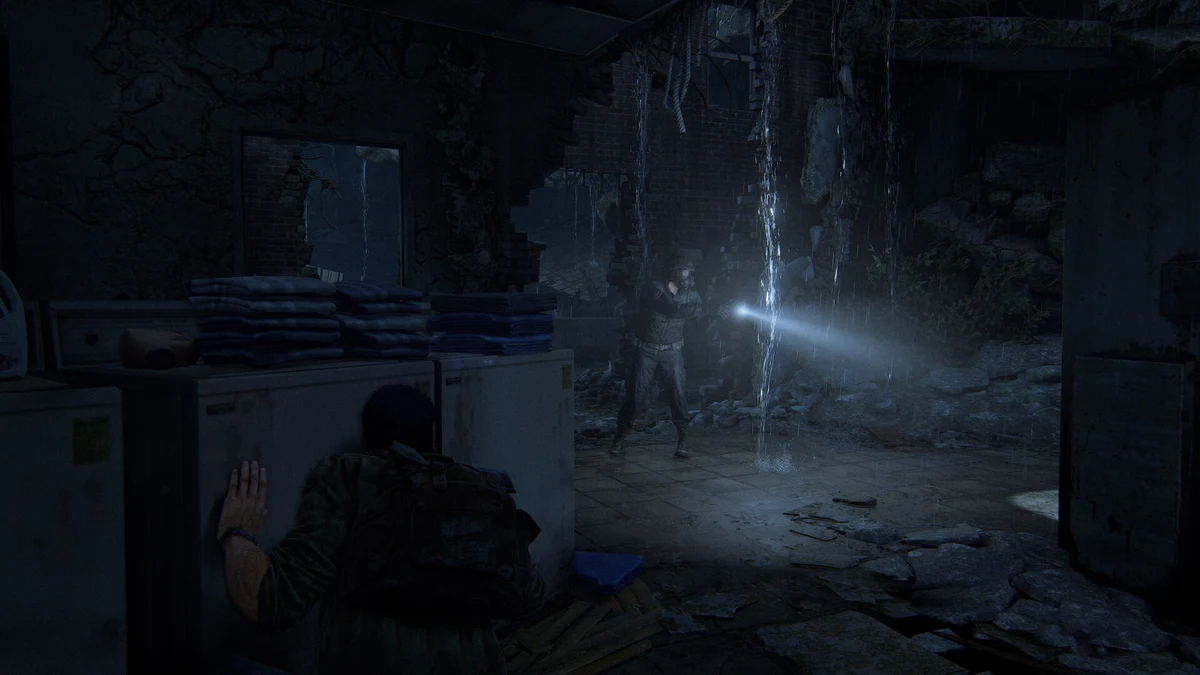
Both entries in the Naughty Dog saga eventually made their way from PlayStation exclusivity to PC, but they arrived years apart and had very different launches. The Last of Us Part I landed on PC on March 28, 2023, following a PS5 release in September 2022, while The Last of Us Part II Remastered launched on PC on April 3, 2025. This guide covers the system requirements for both, how each port performed at launch, and what PC players get that console owners do not. For the bigger picture on both games and the franchise as a whole, check out our complete The Last of Us guide.
The Last of Us Part I PC Requirements
Part I’s PC version asks for a fairly demanding baseline compared to many PS5-era ports, reflecting the fact that it was built on Naughty Dog’s remake engine rather than the original 2013 codebase. The minimum requirements are:
- OS: Windows 10 (version 1909 or later)
- Processor: Intel Core i7-4770K or AMD Ryzen 5 1500X or better
- RAM: 16 GB
- Graphics: NVIDIA GeForce GTX 970 (4GB) / GTX 1050 Ti (4GB) or AMD Radeon RX 470 (4GB) / RX 6500 XT (4GB)
- Storage: approximately 100 GB
For a smoother experience, the recommended specification steps up to an NVIDIA GeForce RTX 2070 Super or RTX 3060, or an AMD Radeon RX 5700 XT or RX 6600 XT, both with 8GB of VRAM. The PC version supports NVIDIA DLSS Super Resolution and AMD FSR 2.2 for upscaling, along with adjustable texture quality, shadows, reflections, and ambient occlusion settings, plus VSync and frame rate cap options not available on console.
The Last of Us Part II Remastered PC Requirements
Part II Remastered’s PC requirements are scaled around three target experiences rather than a single minimum-to-recommended range. To run the game at low settings around 720p at 30fps, you need roughly an Intel Core i3-8100 or AMD Ryzen 3 1300X paired with a GTX 1650 or RX 5500 XT. For a more standard 1080p at 60fps on medium settings, an Intel Core i5-8600 with an RTX 3060 is enough. To push toward 4K at 60fps on the very high preset, Naughty Dog recommends an Intel Core i7-11700 or AMD Ryzen 7 5700X, paired with an RTX 4080 or RX 7900 XT, along with 32GB of RAM. The game recommends roughly 150GB of SSD storage for best load times and streaming performance.
On the features side, Part II Remastered supports NVIDIA DLSS 3 Super Resolution, AMD FSR 3.1, and AMD FSR 4 for both upscaling and frame generation, an uncapped frame rate option, and DirectStorage support for faster asset streaming, none of which exist in the original PS4 release of Part II.
How Part I’s PC Launch Actually Performed
Part I’s PC debut in March 2023 was rocky. The port shipped with long shader compilation times on first launch, unstable frame rates, frequent crashes, and mouse and camera stuttering that made the game difficult to recommend at launch even on hardware that met the recommended specs. Naughty Dog and porting studio Iron Galaxy released a string of post-launch patches that reduced shader compilation time, improved stability during that compilation process, fixed a number of crashes, shortened load times, and improved performance on Steam Deck. Even after these fixes, some shader compilation stutter has remained noticeable for players, and at least one later patch introduced a memory usage spike that caused problems on systems with less than 32GB of RAM, illustrating that the port’s issues were addressed gradually rather than resolved in a single update.
What Changed From the Console Versions
Beyond raw performance settings, the PC ports of both games add options that simply do not exist on PlayStation hardware: uncapped or custom frame rate targets, ultrawide monitor support, a full graphics settings menu for texture quality and shadow resolution, and a choice between multiple upscaling technologies (DLSS, FSR, and in Part II Remastered’s case, frame generation as well) rather than being locked to a fixed console output mode. Keyboard and mouse support is fully implemented in both, alongside continued support for a controller, and both ports retain the accessibility options introduced in their PlayStation Remastered releases, including a wide range of assist settings for navigation, combat, and reading.
Part II Remastered’s PC version also carries over everything added in the PS5 Remastered release, including the No Return roguelike mode, guitar-playable segments, and developer commentary, so PC players are not missing any of the bonus content available on console.
Practical Buying Advice
If your hardware sits closer to the minimum specifications for either game, expect to run at 1080p on lower settings rather than aiming for higher resolutions, and budget extra time for the initial shader compilation step, particularly on Part I, before judging in-game performance. For players with mid-range hardware from the last few years, an RTX 3060-class GPU comfortably handles 1080p at 60fps in both games on medium-to-high settings, while pushing toward 4K or very high presets in either title still benefits from a current-generation high-end GPU given Naughty Dog’s recommended specs for that tier.
Should You Wait for Patches Before Buying?
Given Part I’s turbulent launch history, it is worth checking recent patch notes or user reports before buying either port close to a fresh release, especially if you plan to play at launch on a new title in the series. Part II Remastered’s PC launch in 2025 benefited from lessons learned during Part I’s rollout, but as with any large-scale PC port, waiting a few weeks for early patches to land is a reasonable way to avoid launch-week stability issues if you are not in a rush to start.
Steam Deck and Handheld Performance
Both PC ports received specific attention for Steam Deck compatibility after their initial launches. Part I struggled on Steam Deck at release, with long shader compilation times being especially painful on a handheld’s more limited hardware, but subsequent patches improved load times and stability enough that the game became more consistently playable on Valve’s handheld, typically requiring lowered settings and a target of 30fps rather than 60fps for a stable experience. Part II Remastered’s more scalable settings menu, with dedicated low-end presets built around 720p and 30fps, makes it comparatively better suited to handheld PCs out of the gate, since those lower presets were part of the original requirements planning rather than added after the fact.
Ray Tracing and Console-Exclusive Features
Not every feature moves cleanly between platforms. The PS5 versions of both games include console-specific implementations tied to the DualSense controller, such as adaptive trigger resistance and detailed haptic feedback that simulates different surfaces and weapon recoil. These DualSense-specific features are not replicated on PC even if you connect a DualSense controller via USB or Bluetooth, since they rely on PlayStation’s proprietary controller APIs. On the graphics side, neither Part I nor Part II Remastered relies heavily on hardware ray tracing for its core lighting model, both use baked and screen-space lighting techniques carried over from their PS5 builds, so PC players are not missing a ray-traced mode that exists only on console.
Cross-Save and Save Transfer Considerations
Players moving between a PS5 and a PC copy of either game should check current save compatibility before assuming saves carry over automatically, since cross-save support has been rolled out and adjusted over each game’s post-launch patch cycle rather than guaranteed at launch. Checking the in-game save menu or official patch notes closest to your purchase date is the most reliable way to confirm whether your specific console progress can be continued on PC, or whether you will be starting fresh.
Bottom Line for PC Buyers
Both PC ports are, at this point, functional and generally well-regarded once patched, but they arrived at very different points in their respective optimization journeys. If you are buying either game now rather than at launch, you are benefiting from a substantial amount of post-release patching that earlier buyers did not have. Checking your specific GPU and CPU against the tables above, rather than relying on a general sense of “is my PC good enough,” is the most reliable way to set expectations before buying, especially given how demanding Part II Remastered’s very high preset is compared to its low-setting baseline.
Sources: – The Last of Us Part I System Requirements — sysrqmts.com – The Last of Us Part I for PC – PC Requirements & Features | PlayStation – The Last of Us Part II Remastered PC System Requirements Revealed – Wccftech – The Last of Us Part I – PCGamingWiki – ‘The Last of Us Part I’ hits PC on March 3rd, 2023 – Engadget