Josef Fares and Hazelight Studios have built their reputation on a simple but demanding promise: no two co-op games from this team play the same way twice, sometimes not even within the same level. After the runaway success of It Takes Two, expectations for Split Fiction were enormous, and remarkably, the studio has largely delivered. This is a game that treats “co-op adventure” as a genre container to be refilled every ten minutes, and while the ambition occasionally outpaces the writing, the sheer craft on display makes it one of the most purely enjoyable two-player experiences available on any platform.
Story and Setting
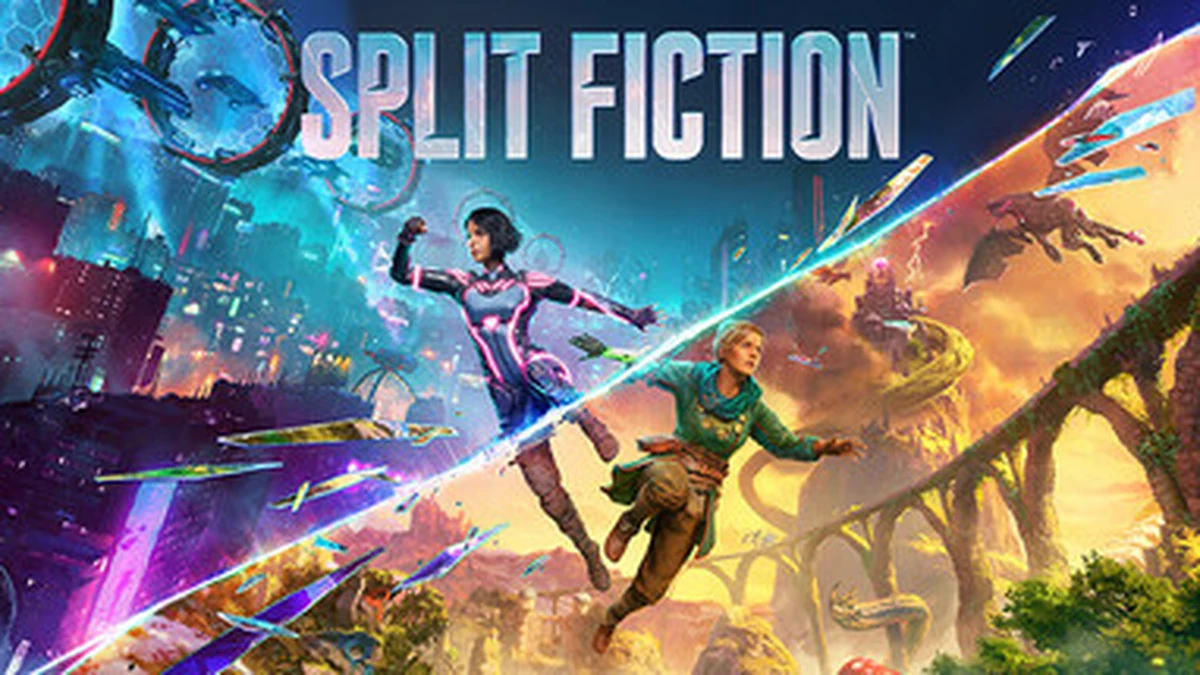
Split Fiction follows Mio and Zoe, two aspiring writers who get pulled into a machine built by a predatory publishing company to literally extract stories from authors’ minds. When the machine glitches, the two women find themselves trapped inside a shared simulation built from fragments of their own unfinished fiction — Mio’s grounded, high-tech sci-fi stories and Zoe’s whimsical fantasy tales — and have to work together to escape. It’s a clever frame that justifies the game’s genre-hopping structure, and the central relationship between two writers with clashing sensibilities gives the constant bickering a purpose beyond comic relief.
The narrative’s weak point is predictability. The overarching threat, tied to the machine and the company exploiting these authors, hits familiar beats that genre-savvy players will see coming well before the credits, and the story is told in a somewhat lopsided way, spending long stretches on one character’s arc before pivoting hard to the other. The character writing carries it regardless — Mio and Zoe’s dynamic evolves believably from friction to genuine partnership, and by the game’s final act, the emotional payoff lands harder than the setup suggests it will.
Gameplay and Co-op Design
This is where Split Fiction distinguishes itself, even against its own pedigree. Nearly every chapter introduces a new mechanical hook — platforming, shooting, racing, puzzle-solving, physics gimmicks, and genre pastiches ranging from cyberpunk shootouts to dragon-riding fantasy sequences — and virtually none of it overstays its welcome. The two playable characters are asymmetric by design, meaning you and your partner are frequently doing genuinely different things that have to sync up, rather than mirroring each other’s inputs. Optional “Side Stories” branch off the main path for bite-sized detours that let the team experiment even further, from goofy minigames to entirely different art styles.
Critically, the game is built around Hazelight’s Friend’s Pass, which lets one person who owns the game invite a second player to join for free, regardless of platform. That single decision removes the biggest historical barrier to couch or online co-op — the double purchase — and it deserves real credit for making the experience accessible. The game only works as two-player, split-screen locally or online; there’s no solo mode, which is worth knowing going in, but it’s a deliberate design choice, not an oversight.
Visuals, Sound, and Performance
Split Fiction is a visual showcase, hopping between vividly realized sci-fi metropolises, storybook fantasy realms, and stranger in-between spaces with a level of production polish that rivals far bigger single-player blockbusters. The split-screen presentation, which dynamically resizes and merges depending on what each player is doing, is a technical achievement in its own right and rarely gets in the way of readability.
Performance is the standout surprise. Across PS5, Xbox Series X/S, and PC, the game runs smoothly with minimal frame issues, and reports of outright bugs or crashes are unusually rare for a game built around real-time split-screen and networked co-op. A later Nintendo Switch 2 port extended that reliability to hybrid hardware, which is no small feat for a game this visually dense. In a year where big releases regularly launch rough, Split Fiction’s technical stability is worth calling out on its own merits.
What Works
The moment-to-moment variety is the whole show, and it rarely falters. Just as one mechanic starts to feel familiar, the game replaces it entirely, and the asymmetric co-op design keeps both players genuinely engaged rather than one carrying the other. The Friend’s Pass is a meaningful, player-friendly decision that lowers the cost of entry, and the technical polish is a legitimate standout in a landscape full of buggy launches.
What Doesn’t
The story’s central conflict is predictable, and its pacing occasionally stalls on one thread for too long before jumping to the other. A handful of the shorter minigames and Side Stories land weaker than the game’s best set pieces, and the character bickering, while purposeful, can grate in longer stretches. None of this undermines the overall experience, but it keeps Split Fiction just short of flawless.
Verdict
Split Fiction is essential for anyone with a regular co-op partner, whether that’s a partner, a friend, or a family member, and the Friend’s Pass makes it easy to try with almost no financial risk to your co-op partner. It’s inventive, gorgeous, technically rock-solid, and consistently entertaining across its roughly 12-to-16-hour runtime, even if the story it’s telling isn’t quite as fresh as the mechanics delivering it. If you don’t have anyone to play with, there’s genuinely nothing here for you — this is a two-player experience through and through. But for the intended audience, it’s one of the best co-op games available right now, and a clear high point in Hazelight’s catalog.